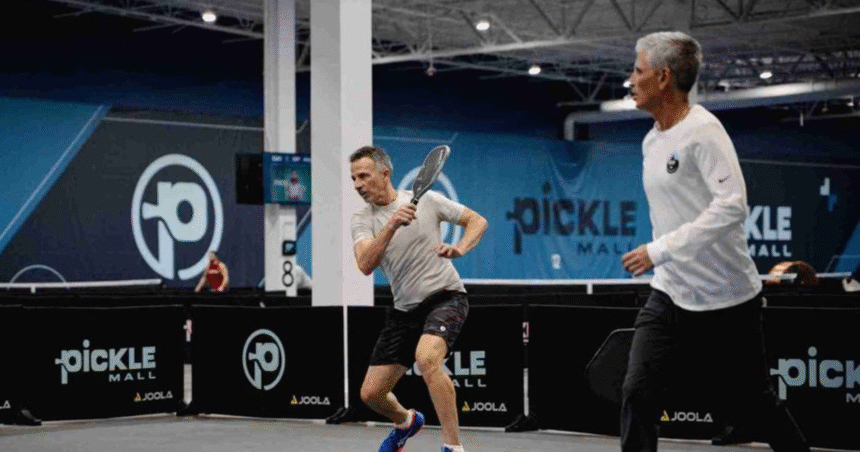
Senior pickleball training fails when players treat every session like a tournament and every rest day like a wasted one. This weekly framework caps high-impact play at three days, spreads strength and mobility across the rest, and keeps your knees, shoulders, and elbows in the game.
Smart senior pickleball training is built around three days of real match play, not seven. That number surprises people.
Walk into open play in Naples or The Villages and you’ll find 60-somethings logging four hours a day, five days a week, then wondering why their knee sounds like gravel.
A habit is not a training routine.
Here’s the thing. The problem isn’t your age. It’s your schedule.
Over 24 million Americans now play pickleball, according to the Sports & Fitness Industry Association, and the 55-plus bracket is the most committed slice of that number.
Committed is good. Undisciplined about recovery is not. Let’s fix the weekly calendar.
Love pickleball? Then you’ll love our free newsletter. We send the latest news, tips, and highlights for free each week.
What Does Senior Pickleball Training Actually Mean?
Senior pickleball training is the deliberate structuring of weekly court time, strength work, and recovery so that a player over 50 improves without accumulating overuse damage.
It’s not a workout plan. It’s a load management plan, closer to how a pro structures on-court rituals than to a gym program.
Training load is the term worth knowing here. It’s the total stress you place on your body across a week, counting intensity and duration together.
Pickleball and the Pursuit of Flow
Pickleball gives people movement, competition, connection, improvement, and joy. But more than anything, it gives them a place to put their full attention.
Three ninety-minute matches is a load. So is one three-hour open play marathon plus a gym session.
The body doesn’t care which label you put on the activity, and neither does your patellar tendon. Senior pickleball training starts with counting honestly.
Good pickleball for seniors treats rest as an input, not a gap between inputs. That’s the whole shift.
Why Is Senior Pickleball Training So Easy to Overdo?
Because pickleball is social, and social activities don’t feel like exercise.
You’re laughing between points, so your brain files the session under “fun” while your rotator cuff files it under “work.”
Even playing the percentages goes out the window.
The injury data backs this up hard.
Clinical epidemiology research published on ResearchGate found that more than 52% of senior pickleball injuries trace back to chronic overuse rather than a single traumatic moment.
Nobody rolls an ankle at hour one. They break down at hour four, on day five, in week nine. It’s the mistake you didn’t know you were making.
Surveillance research indexed on PubMed puts the knee and lower extremities at roughly 30% of reported musculoskeletal cases in older players, with ankle and Achilles strains next, then shoulder trouble.
A separate PubMed-indexed review of pickleball injury patterns reaches the same conclusion about volume being the driver.
Tissue repair happens during rest. Not during your sixth game.
Any senior pickleball training plan that skips that step is just scheduled decline with a nicer name.
If your body isn’t recovering, your muscle care routine is doing damage control instead of building anything.
💡
The 3-2-1-1 Framework for Senior Pickleball Training
The 3-2-1-1 framework caps high-impact play at three days per week, assigns two days to off-court strength, one day to active recovery, and one day to complete rest.
Four categories, seven days, zero guesswork.
I like this structure because it’s honest about the tradeoff: less court time, more court years. Here’s how the week lays out, and how it changes team practice.
Monday and Friday: Where Senior Pickleball Training Gets Competitive
These are your full-speed match days, 60 to 90 minutes each. Play hard. Keep score. Chase the ball you shouldn’t.
One rule, no exceptions: never start cold. Fifteen minutes of dynamic warm-up before the paddle touches a ball.
To make it less of a chore, mini-ball routines wake up hand speed fast.
Post-match: 25 to 30 grams of protein inside 40 minutes, then five minutes on calves and shoulders. Nutrition timing matters more at 62 than at 32, and so does water intake.
5 Pickleball Exercises for Seniors to Protect Every Joint
Protect your knees, hips, shoulders, and elbows with these 5 research-backed pickleball exercises for seniors. Learn how targeted joint conditioning can prevent common court injuries, improve lateral agility, and keep you playing pain-free.
Tuesday and Saturday: The Strength Work Nobody Posts About
Two off-court sessions, 35 to 45 minutes each. This is the least glamorous part of senior pickleball training and the part that keeps you playing.
Tuesday builds the big movers:
- Goblet squats for knee deceleration, the exact quality you need to stop at the kitchen line
- Lateral band walks for the side-to-side shuffling that defines doubles
- Pallof presses for low-back protection during rotation
- Farmer’s carries for grip strength, which quietly stabilizes your whole paddle arm
Saturday’s pickleball exercises for seniors target balance and shoulder longevity: single-leg stands, step-ups, resistance band external rotations, hamstring lengthening.
That shoulder work pays off every time you reach for an overhead.
Thirty-five minutes. Twice a week. That’s the whole ask.
The Best Drills for Beginners: Pickleball Training Routine
The best drills for beginners build fast hands, steady dinks, and a reliable third shot drop, all in one simple weekly routine. This guide breaks down exactly which drills to run, in what order, and how long each one should take.
Wednesday: Drilling Day, aka Free Skill Points
Wednesday is 45 to 60 minutes of controlled drilling and skinny singles. Low impact, high return.
You build skill without the sprinting and hard stops that eat cartilage, which is how 3.0 players become 3.5s.
Focus the soft game. Cross-court dinking, third shot drops, and resetting out of the transition zone.
The hardest dinking drill is a good ceiling test, and the figure-8 drill sharpens footwork without pounding joints.
Working alone? Solo drills cover more ground than you’d think.
Honestly, this is the day that separates the 3.5 who stays a 3.5 from the one who becomes a 4.0. Match play reveals your game; drilling changes it.
Getting better at resets alone will win you more points than any new paddle.
Thursday and Sunday: How Much Rest Does Senior Pickleball Training Need?
Senior pickleball training needs one active recovery day and one complete rest day per week, minimum. Thursday is the active one, Sunday is the real one.
Thursday: 30 minutes of brisk walking or light swimming, 90/90 hip stretches, foam rolling.
You’re flushing the system and opening hips that spent five days half-crouched. Recovery tools help, though nothing beats the walk.
Sunday: nothing. No court, no heavy lifting, no “just a couple games.” Sleep, hydrate, rebuild.
If soreness is still with you Monday morning, your Sunday wasn’t a rest day.
Pro Pickleball Drilling Routine: Train Like a 6.0 DUPR
This advanced pickleball drilling routine focuses on building consistency, cleaner attacks, and faster hands under pressure.
Three Rules That Make Senior Pickleball Training Stick
The framework only works if three habits hold. Miss these and the calendar becomes decoration, like teamwork tips nobody applies.
Rule 1: Warm Up Like You Mean It
Stepping out of the car and onto the court is the single most common self-inflicted injury in senior pickleball training. Fifteen minutes, broken into three pieces: three minutes of marching or side-shuffling to raise core temperature, seven minutes of leg swings, hip circles, arm circles, and torso rotations, then five minutes of soft dinking to dial in vision and timing. Your stance and setup should feel automatic before the first real point.
Rule 2: Check Your Paddle Before You Blame Your Elbow
If your elbow aches, look at your equipment before you look at your technique. Heavy paddles send vibration straight up the flexor tendons, and it shows up on power shots first. Move to a 7.3 to 7.8 ounce paddle with a shock-absorbing polymer core, and confirm it still meets equipment standards published by USA Pickleball before you enter anything sanctioned. While you’re auditing gear, your shoes matter just as much for lateral support.
Rule 3: Deload Every Fourth Week
Every four to six weeks, cut volume in half. Three match days becomes one or two lighter ones. Keep the strength work, keep the walk, drop the intensity. Tendons repair micro-damage during deloads, which is why pro blocks are built the same way, even for players who sweat through singles at 25.
4 Rules to Help the Weaker Player Win More Pickleball Games
Being the weaker player pickleball doesn’t have to mean handing opponents free points. These four rules give you a plan that wins games without relying on raw talent.
How Do You Know Your Senior Pickleball Training Is Working?
You’ll know senior pickleball training is working when your third game feels like your first, and when Monday morning doesn’t require an inventory of what hurts.
Track three things. Whether Friday matches Monday’s movement quality. Whether soreness clears within 24 hours.
And whether unforced errors drop late in matches, a conditioning number disguised as a skill number. Watch your mid-court decisions in game three.
If all three trend the right way for a month, add volume. If any one slips, deload. That’s the entire feedback loop.
Pickleball Fitness for Seniors: Train Safe, Play Better
Pickleball fitness for seniors is the difference between playing twice a week and playing every day without breaking down. This guide breaks down the exact training approach that lets older players compete harder and recover faster.
Key Takeaways
- Cap high-impact match play at three days per week. More than that, and overuse compounds faster than fitness improves.
- Overuse causes over 52% of senior pickleball injuries, not single traumatic events.
- Two 35-minute strength sessions beat two extra hours of open play, and sharpen your third shot too.
- One active recovery day and one full rest day are non-negotiable. Adaptation happens during rest.
- Deload every four to six weeks by cutting volume in half. Use the time on shot selection.
- Warm up 15 minutes, every time. No exceptions, no shortcuts, same as the beginner fundamentals that never stop mattering.
💡
Frequently Asked Questions
How many days a week should a senior play pickleball?
Three days of competitive match play per week is the sweet spot for players over 50. Add two short strength training sessions, one active recovery day, and one full rest day. Players who go beyond four high-intensity days report more knee and shoulder complaints than those who hold at three, which is why strength training for pickleball belongs in the schedule instead of a fourth match.
Is pickleball bad for your knees after 60?
Pickleball for seniors isn’t inherently bad for knees, but the volume most people play at often is. Research indexed on PubMed attributes roughly 30% of musculoskeletal cases in older players to knee and lower extremity issues, largely from repeated hard stops without adequate strength support. Eccentric quad work like slow step-downs and goblet squats builds the braking strength that protects the patellar tendon and improves court coverage in doubles.
What’s the best warm-up for senior pickleball training?
The best pickleball warm up is fifteen minutes in three phases: three minutes raising core temperature with marching or side-shuffling, seven minutes of dynamic mobility including leg swings and hip and torso rotations, and five minutes of soft dinking. Static stretching before play is less useful than dynamic movement, even for a backhand volley. Save long holds for after.
Can you start senior pickleball training after a knee replacement?
Many players return to pickleball after knee replacement, typically at three to six months post-surgery with surgeon clearance. Doubles is the standard recommendation over singles because it cuts total court coverage, and smart doubles positioning cuts it further. Talk to your orthopedic surgeon or physical therapist before setting a return date.
How do you prevent pickleball elbow as an older player?
Reduce vibration at the source and build tendon tolerance. Switch to a 7.3 to 7.8 ounce paddle with a polymer core, check your grip size isn’t too small, and add slow eccentric wrist extensions twice a week. Most cases of pickleball elbow are equipment and volume problems, not technique problems.
Nguồn: thedinkpickleball