Most pickleball players are training their core in a way that does nothing for their game. These four pickleball core exercises build the rotational strength that actually transfers to the court.
Your pickleball core exercise routine might be the most wasted time in your training.
If you are grinding through sets of crunches, sit-ups, or long planks, you are not building the kind of core strength that helps you hit harder, rotate faster, or hold your ground at the kitchen line.
A smart pickleball core exercise routine is the difference between a core that looks strong and one that actually performs.
The problem is simple. Those exercises train your core in isolation, with minimal load, through patterns that almost never show up in your actual game.
Pickleball demands rotation, lateral stability, and explosive power through the trunk.
Crunches give you none of that.
These four exercises come from That Pickleball Trainer – Connor Derrickson on YouTube, a coach who works with pros like Anna Bright and uses the same system for amateur players trying to add real pop to their game.
Love pickleball? Then you’ll love our free newsletter. We send the latest news, tips, and highlights for free each week.
Why Standard Core Training Fails Your Pickleball Core Exercise Routine
Here is the core truth most players miss: doing 50 crunches is not strength training.
It is conditioning at best, and not even sport-specific conditioning at that.
Think about how you would train your legs for pickleball. You would not do 100 bodyweight squats every day.
You would load a barbell, keep your reps in a reasonable range, and actually stress the muscle enough to force adaptation.
5 Pickleball Drills That Turn Weak Shots Into Weapons
Pros Zane Navratil and John Cincola built five pickleball drills that attack the exact shots most players avoid. Steal all five and turn your weak spots into weapons.
Your core deserves the same treatment.
Pickleball asks your core to do three things:
- Flex and extend (forward and backward movement)
- Laterally flex and extend (side to side stability)
- Rotate around the spine (every single shot you hit)
Most players only train the first one. That leaves two thirds of your core undertrained and weak right where pickleball hits hardest.
If you want to hit overheads with authority, drive through volleys, and stay stable during extended dink rallies, you need a different approach.
Here is exactly what to do instead.
Exercise 1: Cable Chops and Lifts
Cable chops and lifts are the best single exercise category you can add to your pickleball training.
They hit the obliques and the rectus abdominis through patterns that directly mirror what happens during every shot you take on the court.
There are three ways to run these. Start with whichever fits your current setup and rotate through all three over time.
- Anti-rotational chop (downward): Stand in an athletic base, cable set high. Pull the rope or bar downward using only your core, resisting any rotation in your torso. Think about moving the weight with your obliques, not your arms or shoulders.
- Anti-rotational lift (upward): Same concept, cable set low. Drive the weight upward while keeping your lower body locked in. You are resisting the pull, and that resistance is what builds real strength.
- Rotational chop: Here you actually let the upper body rotate with the cable. Keep your lower body as still as possible and drive the weight with full rotational force. This is the most sport-specific variation because it mirrors the hip-to-shoulder sequence of a hard volley or overhead.
Focus on the mind-muscle connection. Stop thinking about your arms.
Think about your obliques moving the weight, and the results will be completely different.
These obliques power every rotation you make on the court. I
f you want to understand how that rotation shows up in real shot-making, read about how to hit a forehand in pickleball and notice how much the trunk drives the swing.
This is the heart of any real pickleball core exercise program: load, not repetition.
💡
Exercise 2: Med Ball Rotational Throws
Building strength is only half the equation. You also need to express that strength at speed.
Med ball rotational throws are how you train your core to fire fast, which is exactly what pickleball demands.
Use a six to eight pound ball. Keep reps at five to six per side for three sets. Go over that number and you are no longer training power, you are just getting tired.
Here are the three variations that translate most directly to pickleball:
- Scoop toss: Load the ball on your back hip. Drive your hips toward the wall first. Let the arms follow. The hips lead, the upper body slings through. This is exactly the sequencing you need for powerful groundstrokes.
- Shot put throw: Ball loaded at chest height, elbow directly behind the ball. Same hip-first sequence, then explode through the back of the ball into the wall. This one builds the upper-body snap that shows up on speed-ups and drives.
- Rotational overhead slam: Reach up as high as possible and slam the ball toward the ground near your opposite foot. Throw your hips back as you go. This trains the overhead pattern and the flexion sequence that crunches are trying to train, but with actual load and intent.
The goal on every single rep is to break the wall or break the ground. Max effort every time. If you are coasting, you are wasting the set.
This kind of explosive rotational core training connects directly to pickleball overhead shots, where that hip-to-shoulder sequence is the difference between a put-away and a popup.
Pickleball Training Plan for Competitive Players
Whether you’re pushing from 3.5 to 4.0 or grinding toward 4.5, this week-by-week system gives you the structure to get there.
What Does Anti-Extension Actually Mean?
Anti-extension is a term worth understanding if you are new to real pickleball strength training.
It means your core is resisting the tendency of your lower back to arch and extend under load.
When you keep your back flat during a dead bug, that is anti-extension work.
It builds the deep stability that protects your spine and keeps your whole body connected during fast movements.
8 Lower Body Exercises for Explosive Pickleball Legs — No Gym Required
Pickleball is a game of quick lateral movements, explosive pushes, and stable positioning – your legs are doing most of the heavy lifting
Exercise 3: Dead Bugs
Dead bugs train the flexion and extension pattern of the core.
More specifically, they train anti-extension, which means you are building the ability to keep your spine stable while your limbs are moving under load.
This matters enormously in pickleball.
Every time you reach for a wide ball, stretch into a return, or hold your position through a long rally, your core is resisting extension.
Dead bugs make that resistance automatic.
Progress through these variations as you get stronger:
- Wall dead bug: Lie on your back with a wall behind your head. Push your hands lightly into the wall and keep your entire back flat on the floor. Lower one leg at a time, tapping your heel down, then returning. Start here if dead bugs are new to you.
- Standard dead bug: No wall. Lower opposite arm and leg simultaneously, keeping your lower back pinned to the ground the entire time. Return to center and switch sides.
- Band-resisted dead bug: Hold a resistance band tight overhead throughout the movement, only moving the legs. The band forces constant core engagement and is excellent for learning to brace properly.
- Weighted dead bug: Hold a five to twenty-five pound plate or dumbbell with both arms extended. Lower the weight as one leg drops. This version seriously challenges the rectus abdominis.
Aim for six to eight reps per leg across two to three sets. Slow and controlled beats fast every time here.
Solid core stability is what keeps your positioning tight during long rallies.
Pair this training with smart pickleball footwork and your court coverage will improve significantly.
Dead bugs are a staple in every serious pickleball core exercise plan for a reason.
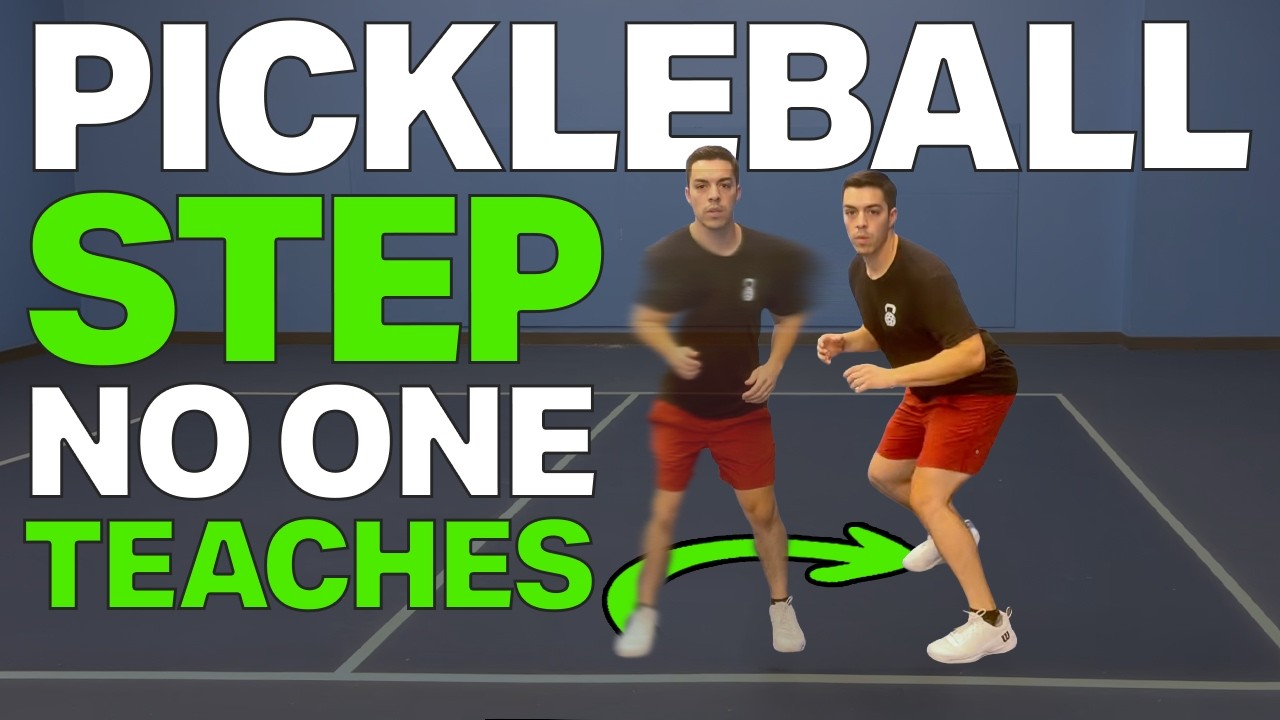
Pickleball Footwork: The Complete Drop Step Guide
The drop step is the pickleball footwork move that stops you from getting beaten by lobs. Coach Ty Woody breaks down 3 movements to fix your backward movement and take control of the court.
Exercise 4: Reverse Crunches
Reverse crunches are the one crunch-adjacent exercise that actually earns a spot in a serious training program.
The key is how you do them, because most people get this wrong too.
The movement is simple but unforgiving when done correctly. Lie on a bench and hold the back of it lightly with one or two fingers. Bent knees at ninety degrees.
Now think about lifting your hips and glutes straight up toward the ceiling first, then curling them toward your face.
That upward lift is what makes this hard. If you just curl toward your face, you are leaving most of the benefit on the table.
Lower as slowly as possible on the way down. Three or more seconds on the descent.
That slow eccentric is where the real muscle building happens, and it is the same principle that coaches use for building bigger, stronger legs through tempo squats.
Two ways to run this:
- Bench version: Lighter grip equals harder movement. Use one or two fingers. Let your hips touch the bench at the bottom, then drive back up.
- Floor version with a kettlebell: Hold a light kettlebell above your head while lying on the floor. A lighter weight actually makes this harder because you have to control the movement entirely through your core. Do not default to a heavy weight just to feel stable.
You can also place a foam roller behind your knees and squeeze it throughout the movement.
This adds tension through the legs and increases the difficulty by around ten to twenty percent.
This exercise targets the lower portion of the rectus abdominis, the front show muscles that also play a real role in generating power on drives and overheads.
Anna Bright trains reverse crunches as part of her core program, and if you watch her handle fast exchanges at the kitchen, the connection between stable core and sharp hands becomes obvious.
Want to understand how that core power actually shows up during fast net exchanges?
Check out how to build fast hands in pickleball and you will see exactly why trunk stability matters at speed.
How to Prevent Pickleball Elbow
Knowing how to prevent pickleball elbow can keep you on the court longer and out of the physical therapy waiting room. Here’s what the research says about the exercises, technique fixes, and equipment changes that actually work.
How to Build Your Weekly Pickleball Core Exercise Routine
You do not need to do all four exercises in one session, but you do need to hit them consistently across the week. Here is a simple structure that works:
This is what a complete pickleball core exercise week actually looks like.
- Day 1: Cable chops and lifts (all three variations, three sets each) plus dead bugs (three sets)
- Day 2: Med ball throws (three sets of five to six reps per side) plus reverse crunches (three sets of eight to ten reps)
Keep the med ball throws explosive and treat them like sprints, not cardio. The cable work and dead bugs can be done with more controlled effort.
The bigger picture here is training your core the same way you train any other muscle.
Load it. Stress it. Let it recover and come back stronger.
That is how you build the kind of core that actually helps you boost your agility on the court and stay strong through a full day of competitive play.
If you want to see how this kind of physical preparation connects to better shot-making, take a look at the speed-up patterns that 5.0 players use.
The rotational core strength from these exercises is what makes those patterns possible to execute consistently.
Weak, undertrained obliques are also a major reason players struggle to generate topspin. A strong core gives you the base to swing with full confidence.
Read up on how to hit a roll shot with fast topspin and notice how much the body rotation drives the shot.
One more thing: none of this training replaces smart on-court practice. But it does give your body the physical capacity to execute what you are learning.
Pair strong core strength for pickleball with focused drilling on two-shot pickleball patterns and you will start to notice the difference within a few weeks.
Stop grinding through crunches that do nothing. Start training your core the way it actually works during a real game.
💡
Frequently Asked Questions
Is a pickleball core exercise routine really better than crunches?
Yes, if it trains rotation and load instead of just flexion. Crunches hit one pattern with minimal resistance, while a proper pickleball core exercise routine builds the rotational power and stability the sport actually demands.
How heavy should I go on cable chops and lifts?
Start with a weight that lets you complete eight to twelve reps with full control. As you get stronger, drop the reps and add load the same way you’d progress any other strength exercise.
What’s the difference between anti-rotation and rotational core training?
Anti-rotation means resisting a force trying to turn your body, like holding steady during a cable chop. Rotational training means forcefully turning your body to generate power, like a med ball scoop toss, and pickleball needs both.
How often should you do pickleball core exercise training each week?
Two dedicated sessions a week is enough if you’re training with real intensity and proper loading. More than that without adequate recovery will slow your progress rather than speed it up.
Why do pros like Anna Bright skip traditional ab work for this kind of training?
Because traditional ab work doesn’t build the rotational power or spinal stability competitive pickleball demands. Cable chops, med ball throws, dead bugs, and reverse crunches build the specific qualities that show up as faster swings and harder overheads.
Nguồn: thedinkpickleball