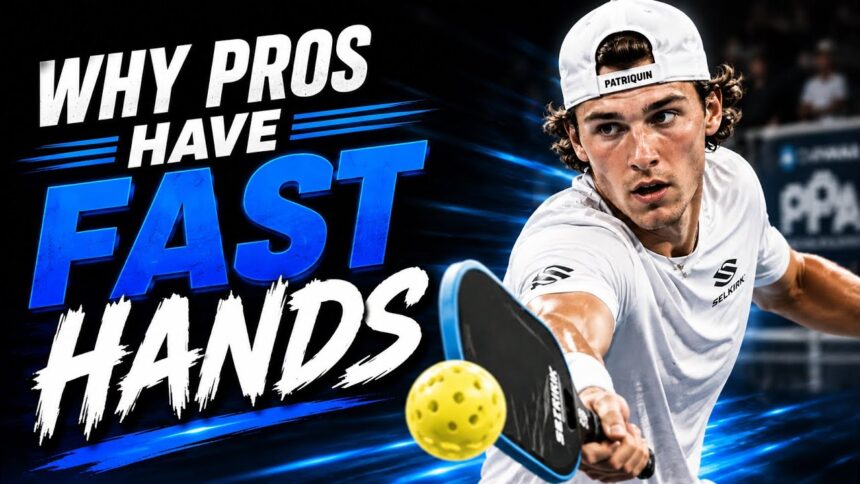
Developing fast hands in pickleball isn’t about arm strength or wild swings. It’s about keeping your paddle on a single plane and understanding the subtle mechanics that separate recreational players from pros.
The difference between a 3.0 and a 5.0 pickleball player often comes down to one thing: fast hands.
- Not arm strength.
- Not athleticism.
- Not even court positioning.
It’s the ability to react, reset, and attack in the kitchen with minimal motion and maximum speed.
Gabe Tardio and Hayden Patriquin, two of the sport’s most dominant players, have mastered fast hands pickleball to a level that makes their opponents look like they’re moving in slow motion.
And according to a recent coaching breakdown from the Dink til you Drop YouTube channel, the secret isn’t as complicated as you might think.
Love pickleball? Then you’ll love our free newsletter. We send the latest news, tips, and highlights for free each week.
What Actually Makes Fast Hands in Pickleball?
Here’s the thing: most players think fast hands come from moving their arms quicker. They don’t.
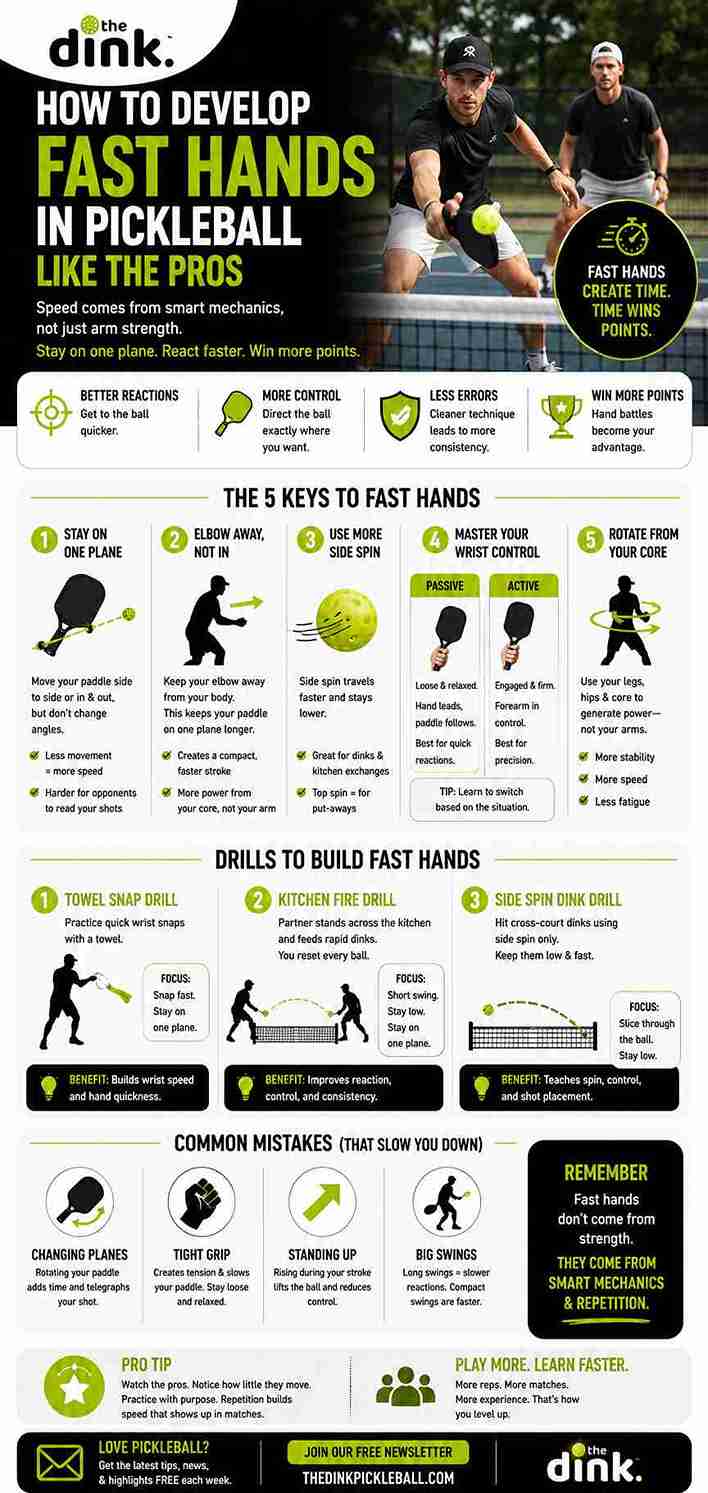
Fast hands come from keeping your paddle on the same plane throughout your stroke.
When you’re in a hand battle at the kitchen line, every millisecond counts. If your paddle is changing planes constantly, you’re wasting energy and time.
You’re also telegraphing your shot, which gives your opponent a split-second advantage to read and react.
The pros do something different.
They keep their paddle face on a consistent plane, moving it side to side or forward and back, but never rotating it through multiple angles.
This creates a whipping motion that’s faster and more deceptive than traditional groundstrokes.
Think of it like this: if you’re trying to snap a towel, you don’t rotate your whole arm.
You keep your wrist and hand in line and snap from the elbow. That’s the feeling you want in your kitchen exchanges.
The Elbow Away Technique: Your Secret Weapon
One of the most effective ways to develop fast hands in pickleball is mastering what coaches call the “elbow away” motion.
This is where your elbow moves away from your body rather than across it.
- When your elbow moves away, your paddle stays on one plane longer.
- When your elbow moves toward your body, your paddle face rotates more, which slows you down.
The difference might seem small, but at the pro level, it’s the difference between winning and losing a hand battle.
Gabe Tardio uses this technique constantly.
His backhand is particularly lethal because he sits on it, keeps his elbow away, and lets the rotation come from his hips and core, not his arm.
This creates a compact, fast motion that’s nearly impossible to defend against.
The key is understanding that fast hands aren’t about arm speed.
They’re about rotational power. Your legs and core generate the force; your hands just deliver it. That’s the four pillars of fast hands in action.
Side Spin vs. Top Spin: Which One Wins in Fast Hands Exchanges?
Here’s something that surprises a lot of players: the pros use way more side spin than top spin during kitchen exchanges.
Top spin is for put-aways. Side spin is for speed.
When you hit with side spin and keep your paddle on one plane, the ball travels faster and with less effort.
You’re not fighting gravity or trying to lift the ball. You’re just carving around it, which creates a flatter, quicker trajectory.
Top spin requires you to go low to high, which means your paddle is constantly changing planes.
That takes time. In a fast hands exchange, time is your enemy.
The best players in the world, like Hayden Patriquin, understand this instinctively. They’re not thinking about it consciously.
They’ve drilled it so much that their hands just know the difference between a situation that calls for side spin and one that calls for top spin.
That’s what separates elite hand speed from the rest of the field.
💡
Passive vs. Active Wrist: Finding Your Balance
Another critical element of developing fast hands in pickleball is understanding the difference between a passive and active wrist.
The Passive Wrist: Speed Through Relaxation
A passive wrist is loose and relaxed. Your hand leads, and your paddle follows. It’s like snapping a towel.
This creates a whipping motion that’s incredibly fast but can be harder to control.
The Active Wrist: Control When You Need It
An active wrist is engaged. Your wrist is in line with your hand, and you’re using your forearm muscles to generate power.
This gives you more control but takes slightly longer to execute.
If you want to master the set-and-snap technique, understanding this distinction is non-negotiable.
The pros use both, depending on the situation. If the ball is coming at them fast and they need to react quickly, they go passive.
If they have a split second more and need precision, they go active.
The ability to switch between these two seamlessly is what separates elite players from everyone else.
The Plane Concept: Why It Changes Everything for Fast Hands in Pickleball
Let’s talk about the most important concept in developing fast hands: the plane.
Your paddle should stay on one plane during kitchen exchanges. Not rotating through multiple angles.
Not going low to high and then side to side. Just one consistent plane.
When your paddle stays on one plane, you can move it faster because there’s less rotational movement.
You’re essentially sliding your paddle along an invisible line rather than rotating it through space.
This is why Gabe Tardio and Hayden Patriquin look so smooth and effortless. They’re not fighting their own mechanics.
Most recreational players violate this principle constantly.
They rotate their paddle, change planes mid-stroke, and wonder why they can’t keep up with faster opponents.
Understanding power vs. fast hands as separate concepts is the first step to fixing this. The solution is drilling the single-plane concept until it becomes automatic.
How Much Should You Practice Fast Hands in Pickleball?
If you’re serious about improving your game, you need to dedicate significant practice time to fast hands in pickleball.
According to coaching recommendations, if you have an hour to practice with a solid partner, spend 25 to 30 minutes on fast hands drills.
That might sound like a lot, but here’s why it matters:
In tournament play, hands win.
Dinking is important, but when the pressure is on and you’re in the finals after playing seven hours, the player with faster hands is the one who’s still sharp.
The 12 drills you need for 2026 include several that directly target hand speed, and they’re worth building into your weekly routine.
The best approach is to start close to the kitchen line and gradually move back as you improve. Have your partner hit balls at you with increasing speed.
Don’t worry about keeping every ball in at first. The goal is to get reps and train your eyes and hands to react to faster speeds.
Once you’re comfortable, add movement. Have your partner move you around while you’re hitting fast hands exchanges.
This trains you to maintain your technique even when you’re off-balance or out of position.
Building Your Fast Hands Pickleball Routine
Developing fast hands in pickleball requires a structured approach. Here’s what a solid routine looks like.
Step 1: Master the Stationary Exchange
Start with stationary exchanges at the kitchen line. Focus purely on keeping your paddle on one plane and using the elbow away motion. Don’t worry about placement or spin. Just get the feel of the motion.
Step 2: Add Movement and Angles
Once that feels natural, add movement. Have your partner feed you balls from different angles. Work on your forehand and backhand separately, since most players have one side that’s stronger. Easy pickleball drills to get faster hands are a great resource for structured progressions you can take straight to the court.
Step 3: Introduce Speed and Pressure
Then introduce speed. Have your partner gradually increase the pace of their shots. This forces your hands to work faster and trains your nervous system to react at higher speeds.
Finally, add pressure. Play out points where you’re starting in a fast hands exchange and trying to finish the point. This teaches you how to transition from fast hands pickleball to put-aways. For more on finishing those exchanges cleanly, 6 essential shots to master for 2026 breaks down exactly when to go for the kill.
The entire routine should take about 30 minutes if you’re doing it right.
Do this two to three times a week, and you’ll see dramatic improvements in your kitchen exchanges within a month.
Why Reload Speed Matters More Than You Think
One thing that separates pros from amateurs is reload speed.
After you hit a fast hands shot, how quickly can you get back to neutral and ready for the next ball?
Most recreational players take too long to reset. They finish their stroke and then slowly bring their paddle back to ready position.
By then, the ball is already coming back at them, and they’re scrambling.
Developing a clean pickleball reset after every exchange is just as important as the attack itself.
The pros finish their stroke and immediately reset. Their paddle is back in ready position before the ball even leaves their opponent’s paddle.
This gives them more time to react and more options for their next shot.
When you’re developing fast hands in pickleball, pay attention to your reload.
Making your practice habits stick using the 70 Rule means training your reload speed just as deliberately as your strike mechanics.
It’s not just about how fast you can hit the ball. It’s about how quickly you can get ready for the next one.
The Mental Side of Fast Hands in Pickleball
Here’s something that doesn’t get talked about enough: the mental aspect of fast hands in pickleball.
When you’re in a fast hands exchange with someone who’s significantly faster than you, it can feel overwhelming.
The ball is coming at you so quickly that you don’t have time to think. You just react.
But that’s actually the goal. Once you’ve drilled the mechanics enough, you want to get to a place where your hands just know what to do without conscious thought.
This is called automaticity, and it’s what separates elite players from everyone else.
If you want to understand exactly what goes through a top player’s mind in these moments, what elite 6.0 players think during every dink is a deep dive worth reading.
The way to get there is through repetition. You drill the same motions over and over until they become automatic.
Then, when you’re in a match and the pressure is on, your hands just execute without your brain getting in the way.
That’s how you break 5.0. Not with raw power, but with mechanics that have been drilled into muscle memory.
A simple 4-step system to win more games in 2026 reinforces the same principle: structure your practice, trust your reps, and the results follow.
💡
Frequently Asked Questions
What’s the difference between fast hands pickleball and just having a fast arm?
Fast hands pickleball comes from keeping your paddle on one plane and using rotational power from your core. A fast arm is just moving your arm quickly, which is slower and less efficient. Fast hands are about technique and efficiency, not raw speed.
How long does it take to develop fast hands in pickleball?
With consistent practice, you can see noticeable improvements in two to three weeks. Significant improvements typically take four to eight weeks of dedicated training. Elite-level fast hands take years of practice to master.
Can I develop fast hands in pickleball if I’m not naturally athletic?
Absolutely. Fast hands are about technique and repetition, not athleticism. Anyone can develop fast hands by understanding the mechanics and drilling them consistently. Some of the best hand players in pickleball aren’t the most athletic people on the court.
Should I focus on fast hands pickleball or other aspects of my game?
If you’re serious about improving, fast hands should be a priority. They’re one of the most important skills in pickleball, especially at higher levels. That said, you still need to work on other aspects like positioning, footwork, and shot selection.
What’s the best drill for developing fast hands in pickleball?
The best drill is simple: have a partner feed you balls at increasing speeds while you focus on keeping your paddle on one plane. Start close to the kitchen line and gradually move back. Do this for 20 to 30 minutes, two to three times a week.
Nguồn: thedinkpickleball