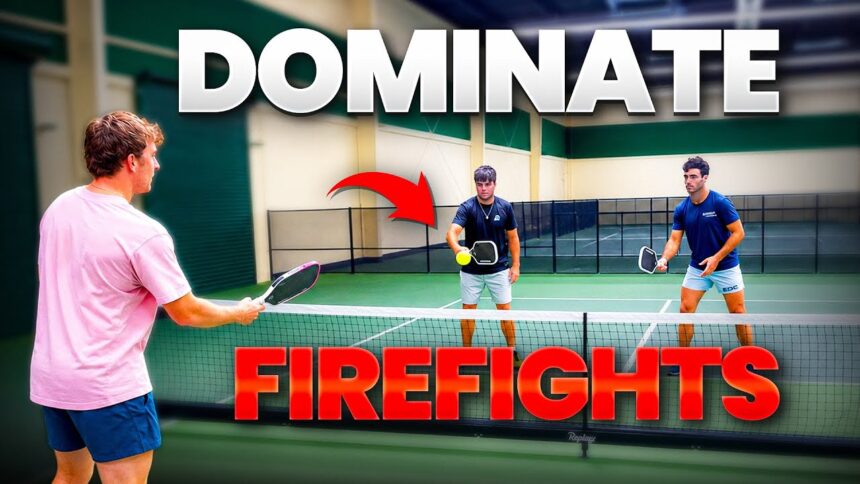
Most pickleball players lose firefights before the ball even reaches them because they don’t understand off-ball positioning. Master the fundamentals of paddle placement, court awareness, and anticipation to become an elite off-ball player.
The difference between good pickleball players and elite ones often comes down to off-ball positioning.
Most players lose firefights before the ball even comes to them because they’re not ready as the off-ball player.
In today’s fast-paced game, your positioning, paddle readiness, and anticipation away from the ball are what separate champions from everyone else.
Love pickleball? Then you’ll love our free newsletter. We send the latest news, tips, and highlights for free each week.
Why Your Paddle Position Matters More Than You Think in Off-Ball Positioning
Here’s the thing: most players make the same critical mistakes when they’re the off-ball player during a firefight.
Richard Pickleball, a leading voice in pickleball strategy, breaks down exactly what separates effective off-ball players from those who get caught flat-footed.
The number one mistake? Letting your paddle drop into a lazy position while your partner and opponent speed up at each other.
When your paddle hangs low or sits passively to one side, you’ve already lost the battle.
- You can’t counter.
- You can’t reset.
You’re essentially useless.
The second common error is positioning your paddle too far to one side of your body.
If you’re sitting with your paddle locked into a forehand or backhand position, you’re limiting your range.
💡
The ball won’t travel from one corner all the way across the court to reach you, but when it does redirect, you need to be ready to move in either direction.
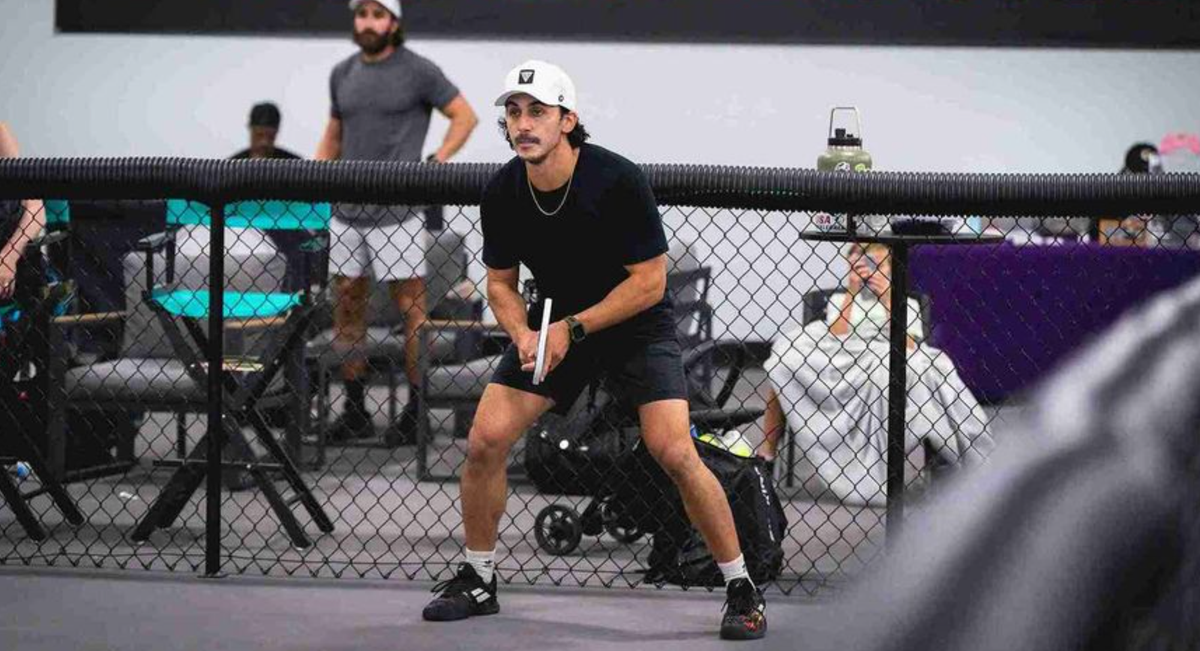
The solution is simple but requires discipline: point the tip of your paddle directly at your opponent.
This isn’t about tracking the ball like you normally would. In a firefight, there’s no time for that.
Instead, keeping your paddle tip aimed at the player in the firefight gives you maximum flexibility.
You can slide backhand or forehand with equal ease, and you’re already in an athletic stance ready to react.
Understanding modern pickleball hand speed and paddle positioning is what makes this click at a muscle-memory level.
What Does Proper Off-Ball Positioning Actually Look Like?
When the firefight is happening up the line in front of you, your job is straightforward.
Whether you’re on the right or left side of the court, get your paddle pointed at the opponent in the firefight.
Then, when the ball redirects, you’re ready to counter it.
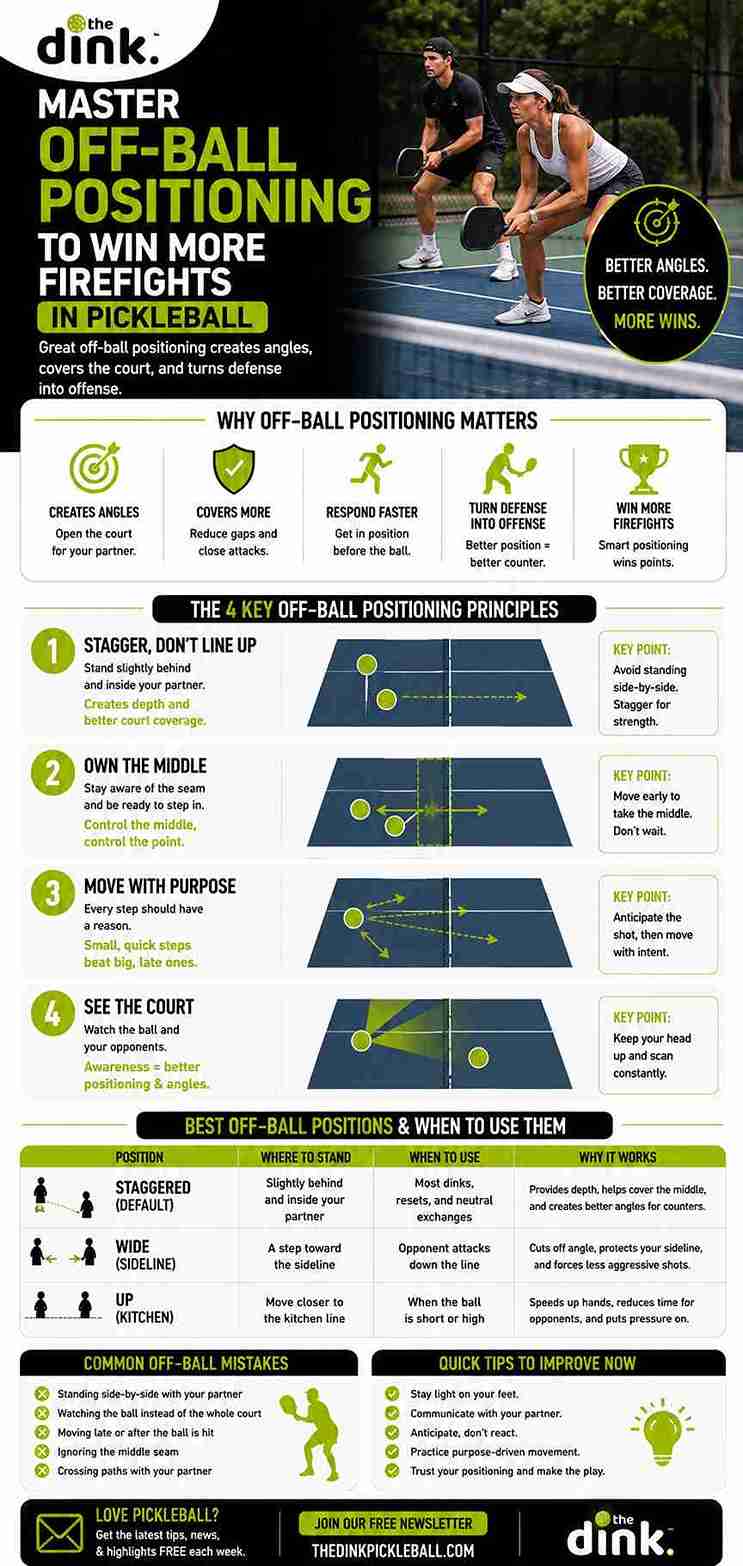
Paddle positioning is the foundation, but it’s not the whole story. You also need to take a half step toward the middle of the court, cutting off angles.
You don’t want to be reaching for the middle ball. You want to be there already, ready to put it away.
The beauty of this approach is that it works regardless of which direction the firefight goes.
Whether your partner is speeding up at the opponent or the opponent is speeding up at your partner, your positioning stays the same.
You’re engaged the entire time, not standing passively while they trade shots.
Good kitchen line court awareness starts exactly here: with your feet, your paddle, and your eyes all aligned before the ball reaches you.
The Cross-Court Firefight: A Different Beast Entirely
Not all firefights happen up the line. One of the most common patterns, especially in doubles play, is the cross-court firefight.
This happens when your partner or the opponent flicks a ball cross-court, and suddenly both players are speeding up at each other across the net.
A lot of players don’t know what to do in this situation. The ball is crossing your face, but you can’t really poach it. So what’s your job?
The answer is packing the middle. This is a concept that separates top-level teams from everyone else.
When your partner is hitting backhands in a cross-court firefight, they’re vulnerable on one specific ball: the redirect that comes back toward the middle of the court.
Your partner is locked into hitting backhands, so it’s hard for them to reach a ball that comes back to the middle. That’s where you come in.
Learn how sitting neutral can transform your counters and understand why your default body position determines everything in a cross-court exchange.
As you see the cross-court firefight developing, creep toward the middle of the court.
Keep your paddle pointed at your opponent, but position yourself to clean up any redirect that comes your way.
- If you’re a righty, you’ll be heavy on your backhand.
- If you’re a lefty, you have more flexibility to stay neutral.
When you do this right, it becomes almost like a wall.
Both players on your team are backhand-heavy, and the forehand spot really isn’t available because one of you can take it.
It’s a pattern you’ll see all the time with top professional teams, and it’s one that will win you significantly more firefights.
Who Covers the Middle in Pickleball Doubles?
In pickleball doubles, who covers the middle is one of the most debated questions on the court. The short answer: the player with the forehand, but the full answer is a lot more nuanced than that.
The Off-Ball Positioning Advantage in Doubles
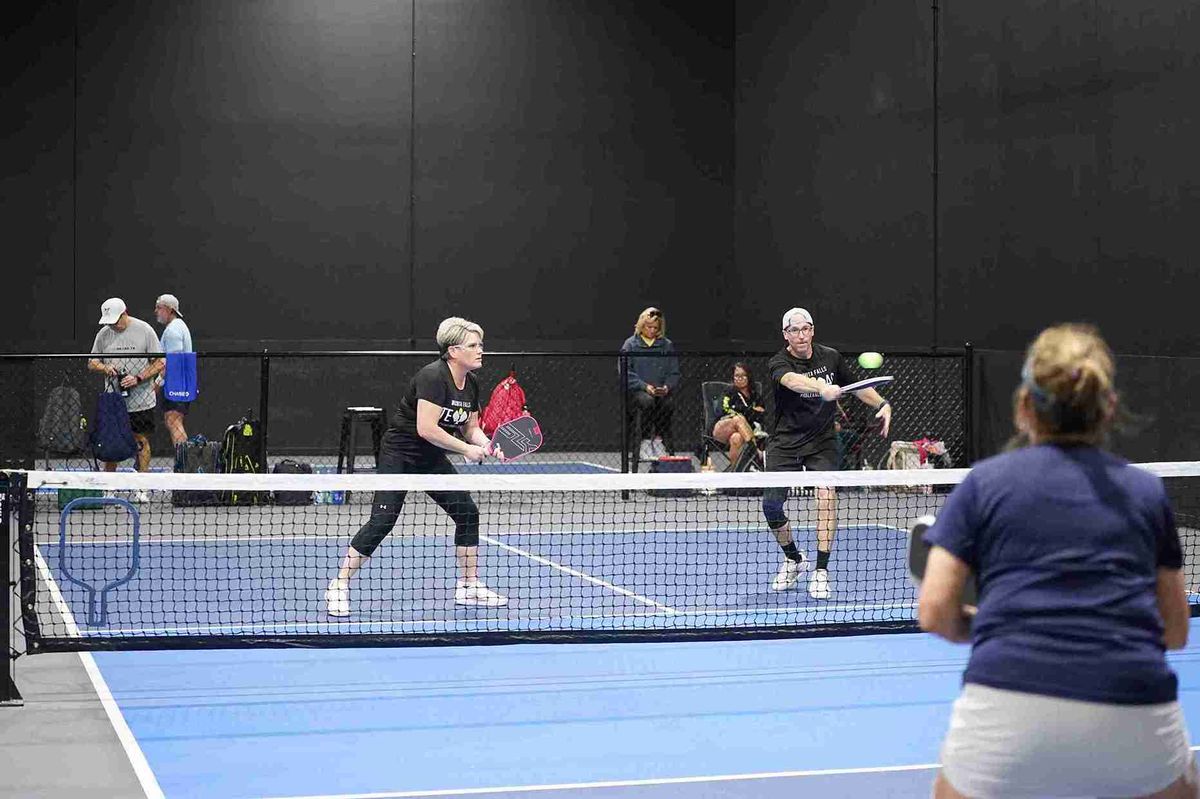
Strong off-ball positioning in doubles isn’t just about defense. It’s a weapon.
When your court coverage is tight and your angles are cut off, opponents feel the pressure even before they pull the trigger on an attack.
The 8 doubles strategies nobody talks about in pickleball include concepts that stack directly on top of solid off-ball fundamentals.
Pair those with sharp pickleball court positioning, and your team starts playing a completely different level of defense.
According to CBS Sports, doubles-dominant sports increasingly reward teams whose non-ball-carrier reads the play two steps ahead rather than reacting after the fact.
The same principle applies at the kitchen line.
Pickleball Shot Placement: Complete Winning Guide
Whether you’re serving, returning, dinking, or driving, knowing where to aim gives you control over the rally and keeps your opponent reacting instead of attacking.
The Mental Game: Anticipation and Trust
Off-ball positioning isn’t just physical. It’s mental too. When you’re in the right position, engaged and ready, your partner feels it.
They know they can speed up and trust that you have their back. They can be aggressive because they know you’re there.
Conversely, if you’re standing passively, your partner will feel that too. They’ll hesitate. They won’t speed up as much.
They’ll feel like they have to do all the work themselves.
An effective partnership is built on trust, and that trust starts with your positioning.
This is why anticipation matters so much in off-ball play. You’re not just reacting to where the ball goes.
You’re predicting where it might go and positioning yourself accordingly.
If your partner is hitting backhands, the ball is more likely to come back to the middle.
If the opponent is attacking, you’re reading their patterns and adjusting.
Pro Michael Loyd’s two-thing rule for hitting consistent pickleball counters is a masterclass in how elite players simplify decision-making under pressure.
That same mental clarity applies directly to your off-ball reads.
The mental warfare elite 6.0 players practice during every dink reveals how much of pickleball court positioning is actually a thinking game disguised as a physical one.
Pickleball Mental Game: Stay Calm Under Pressure and Win
The mental game competitive pickleball demands is just as important as your backhand or your third shot drop. Learn how top players stay calm under pressure, reset after errors, and build the focus that wins matches.
How to Practice Off-Ball Positioning
The good news is that off-ball positioning doesn’t require fancy equipment or a court full of people. You can work on it in drills with just a few players.
Start with basic firefight drills where two players speed up at each other while you practice your positioning.
Focus on keeping your paddle tip pointed at the opponent in the firefight. Work on your half step toward the middle. Get comfortable with the feeling of being ready.
Then move to cross-court firefight drills. Have your partner hit backhands cross-court while you practice creeping toward the middle.
Feel how your positioning changes based on where the ball is going.
The 12 drills you need to play your best pickleball in 2026 includes structured firefight-style repetitions that build the exact habits discussed here.
And if you want to develop the hand speed that makes off-ball opportunities count, the simple drill to get lightning-fast hands is a perfect complement to your positioning work.
The key is repetition. These habits need to become automatic.
When you’re in a real match and a firefight breaks out, you shouldn’t have to think about where to stand. Your body should already know.
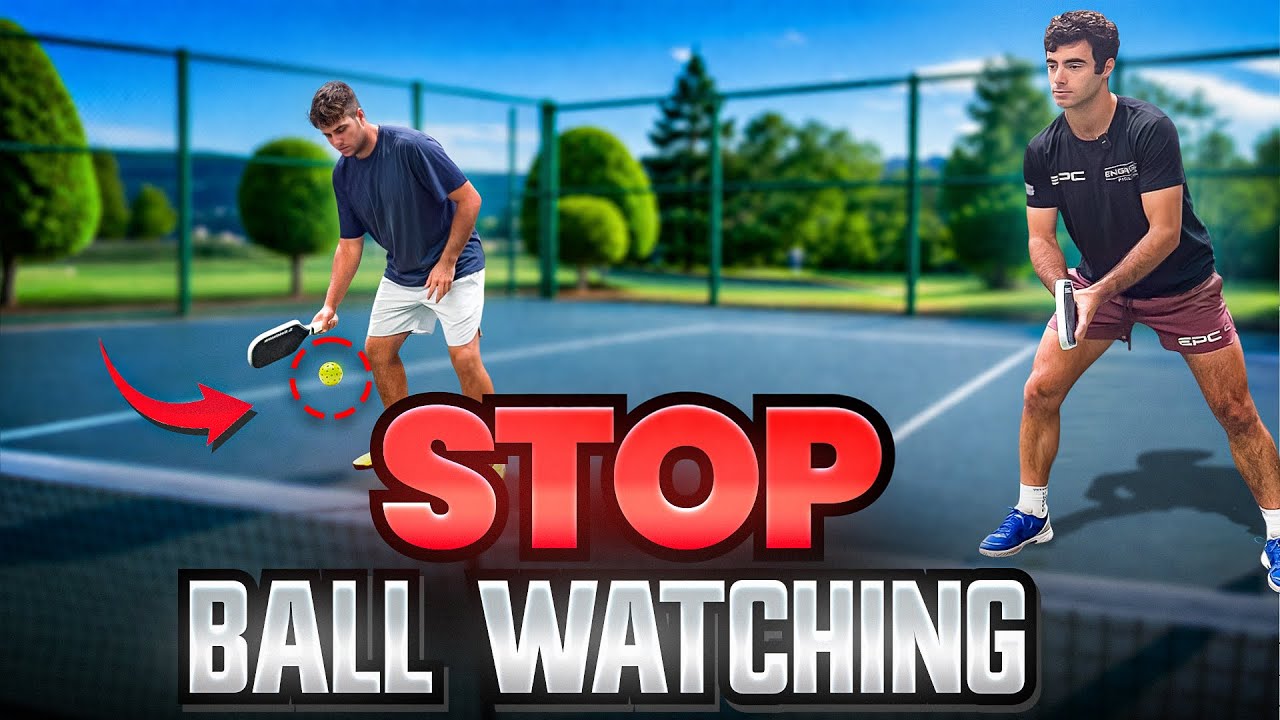
Off-Ball Positioning in Pickleball: Stop Ball Watching
Most pickleball players think the point is decided by whoever hits the ball, but at higher levels, off-ball positioning is what actually controls the court. Master this skill and you’ll transform how you play at the net.
Why Off-Ball Positioning Will Climb Your Rankings Faster Than Any Other Skill
Here’s what’s wild: being the off-ball player is roughly 50% of the game, and yet most players never practice it or even think about it.
They focus on their own shots, their own technique, their own positioning when they’re hitting the ball. But half the time, you’re not hitting the ball.
You’re waiting for it.
That’s where off-ball positioning comes in. Master this skill, and you’ll immediately become a better doubles player. You’ll win more firefights.
- You’ll put away more balls.
- You’ll make your partner feel more confident.
- You’ll climb the rankings faster than you ever thought possible.
The 3 patterns that separate good pickleball players from great ones all share one thing in common: awareness between shots, not just during them.
That’s the off-ball mindset in action. The players who understand this have a massive advantage.
- They’re not just playing pickleball.
- They’re playing chess.
- They’re thinking two shots ahead.
- They’re positioning themselves for success before the ball even gets to them.
Mastering the speed-up attack from the kitchen line is far more effective when your partner’s off-ball coverage gives you the freedom to be aggressive.
One skill builds on the other. That’s how elite doubles teams are built.
According to NBC Sports, the fastest-growing segment of competitive pickleball is doubles, where team positioning and court awareness are becoming the primary differentiators at the 4.5+ level.
💡
Frequently Asked Questions
What is off-ball positioning in pickleball and why does it matter?
Off-ball positioning is how you move, stand, and position your paddle when you’re not the one hitting the ball. It matters because roughly half of every point is spent as the off-ball player, and poor positioning during that time leaves your team exposed to redirects and middle attacks.
What’s the most important thing about off-ball positioning?
Your paddle position is the foundation. Keeping your paddle tip pointed at your opponent in the firefight gives you maximum flexibility to react in either direction, and this single adjustment will improve your off-ball play immediately.
How do I know if I’m in the right position during a firefight?
If you’re getting hit with redirects, you’re not in the right place. If you’re consistently ready to counter or put away balls, you’re doing it right. Pay attention to how your partner reacts too. If they’re confident and aggressive, you’re probably in a good spot.
Is off-ball positioning different for righties and lefties?
Yes and no. The fundamental principle stays the same: paddle tip pointed at your opponent. But the specific positioning can vary based on your grip and which side of the court you’re on. Lefties have more flexibility in cross-court firefights, while righties tend to be heavier on their backhand.
How long does it take to master off-ball positioning?
Like any skill in pickleball, it depends on how much you practice. If you’re intentional about working on it in drills and matches, you should see noticeable improvement within a few weeks. True mastery takes longer, but the fundamentals can click pretty quickly.
Nguồn: thedinkpickleball