Learning how to serve in pickleball for beginners starts with understanding two simple rules: keep it underhand and aim cross-court. Master those basics and you have a legal, reliable serve that holds up under pressure every single time.
Learning how to serve in pickleball for beginners is the single best investment you can make in your early game. Every rally starts with the serve.
Get it wrong and you never even get to play the point.
Get it right and you start with an immediate advantage, putting your opponent on defense before the ball crosses the net for the first time.
Here’s what matters: the pickleball serve is not complicated, but it has specific rules that catch new players off guard.
A few minutes understanding the mechanics will save you from foot faults, illegal serves, and side-outs that cost you games you should’ve won.
Love pickleball? Then you’ll love our free newsletter. We send the latest news, tips, and highlights for free each week.
What Are the Serving Rules in Pickleball?
The pickleball serve must be hit underhand, with the paddle contact point below the server’s waist, and aimed diagonally cross-court into the opponent’s service box.
That’s the foundation. Everything else builds from there.
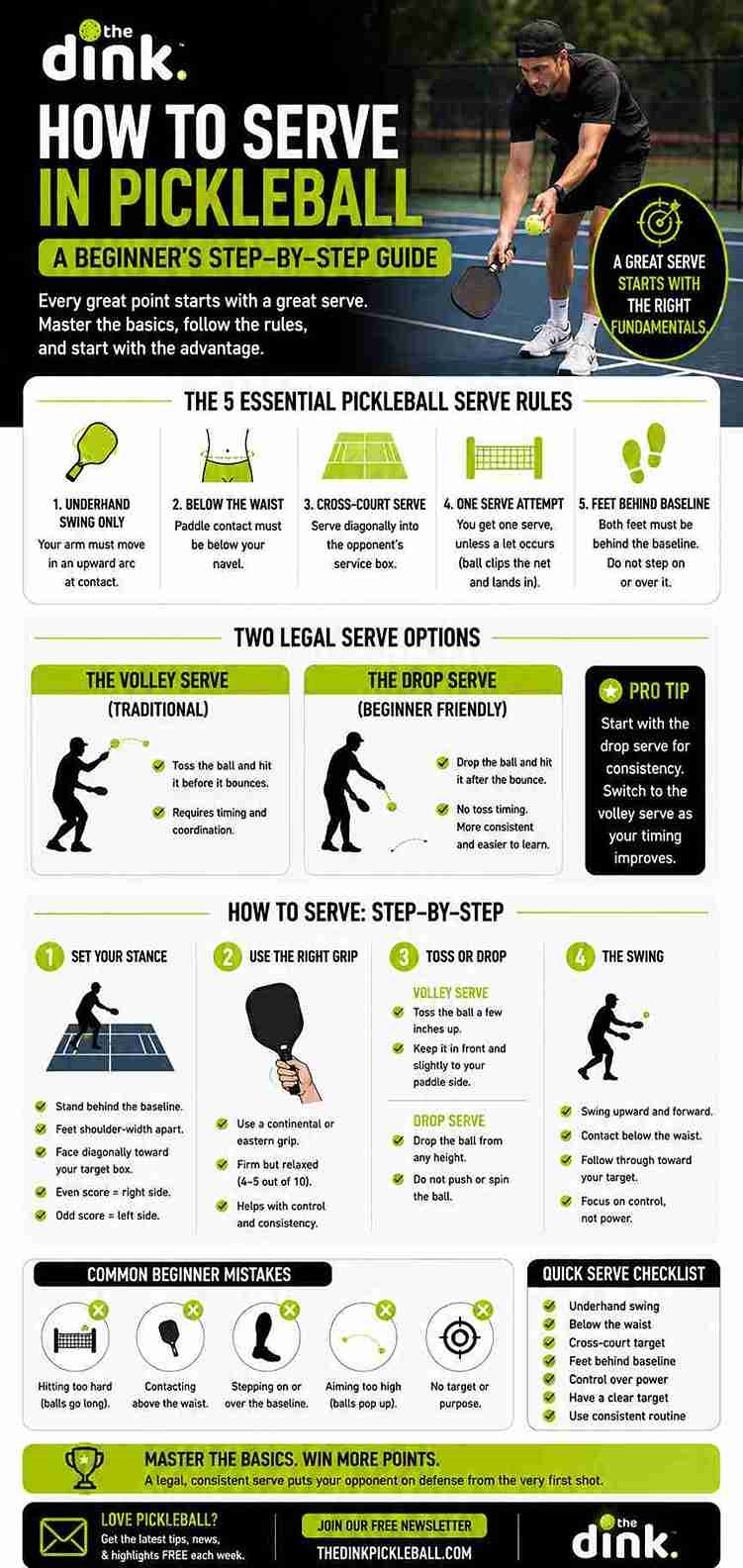
According to the USA Pickleball Official Rulebook (2025), there are five core serving rules every beginner needs to internalize:
- Underhand swing only. Your arm must move in an upward arc at contact. No sidearm. No overhand.
- Paddle contact must be below your waist. Specifically, below your navel. This is the rule beginners most frequently break.
- The serve lands cross-court, clearing the kitchen (non-volley zone) and landing in the diagonal service box.
- You only get one serve attempt, unless a let occurs (the ball clips the net and still lands legally).
- Both feet must be behind the baseline when you serve. Either foot touching the baseline or crossing it is a foot fault.
That’s it. Five rules. If you want a full breakdown of pickleball rules for beginners, bookmark that for later, but these five cover 95% of what you need right now.
The Two Legal Types of Pickleball Serve
Beginners have two legal serve options in pickleball: the volley serve and the drop serve.
Understanding the difference helps you pick the one that matches your skill level, and your nerves on game day.
The Volley Serve (Traditional)
The volley serve means you toss the ball into the air and hit it before it bounces. This is what most players picture when they think of a pickleball serve.
It requires coordination between your toss and your swing, but once you groove the motion, it becomes automatic.
💡
The key mechanical requirements:
- The toss doesn’t have to be high. A few inches off your palm is enough.
- Contact happens on the upswing, below your waist.
- Your arm motion is an upward arc, not a full swing like you’re hitting a forehand drive.
For more on grip options that work best with the volley serve, this breakdown of serve grips is worth a few minutes.
The Drop Serve (Beginner-Friendly)
The drop serve was made a permanent rule by USA Pickleball in 2023, and it’s a game-changer for new players.
You simply drop the ball from any height (without throwing it upward or adding force) and hit it after it bounces.
Why beginners should start here: the drop serve eliminates the timing challenge of the toss-and-hit.
The ball bounces up naturally, giving you a clean, consistent contact point every time.
No wrist position rules apply on drop serves either, so you can hit with topspin or slice if you want. Full detail on the drop serve mechanics is here.
How to Serve in Pickleball for Beginners: Step-by-Step
To serve correctly in pickleball, beginners should focus on four fundamentals: stance, grip, toss or drop, and a controlled upward swing aimed cross-court.
Here’s the step-by-step sequence:
Step 1: Set Your Stance
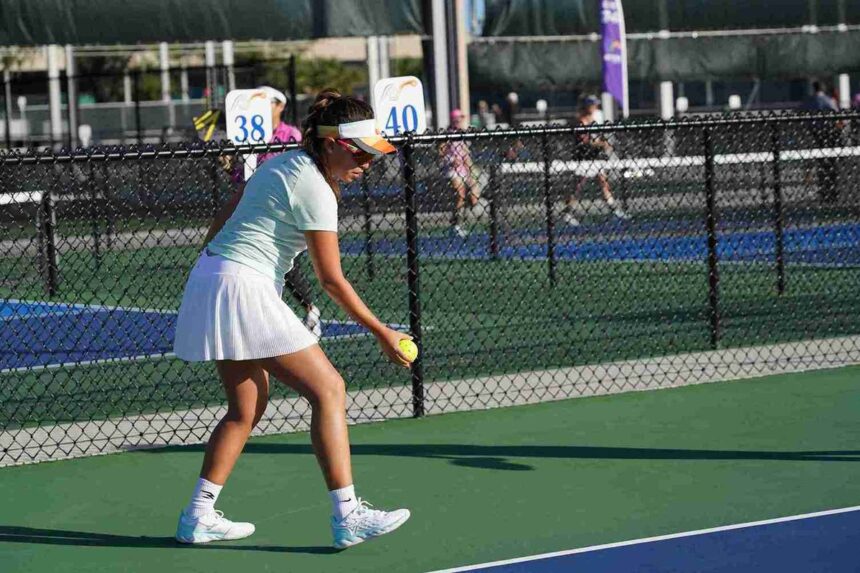
Stand behind the baseline, feet shoulder-width apart, facing diagonally toward your target service box. Your weight should be slightly forward on your front foot, not locked back on your heels. Good court positioning starts before the ball is even in play, so treat your serve stance as the foundation of your entire point.
Right-handed players typically serve from the right service box first, targeting the opponent’s right box diagonally. The score determines which side you serve from, even score from the right, odd score from the left.
Step 2: Use a Continental or Eastern Grip
Most beginners default to whatever grip they used in tennis or just grab the paddle however feels natural. That usually works fine to start. But if you want consistency, a continental grip (the “handshake” grip where your knuckle aligns with the top bevel of the paddle) gives you the most neutral, repeatable contact for serve mechanics.
Grip pressure matters too. Squeezing too hard causes your arm to tense up, which kills swing fluidity. Aim for a 4 or 5 out of 10, firm enough to control the paddle, relaxed enough to move freely.
Step 3: The Toss (or Drop)
For the volley serve: hold the ball lightly in your non-dominant hand, fingers loose, and release it just a few inches upward with a gentle push. Do not flip or spin the ball during the release. The ball should stay in front of your body, slightly to your paddle side.
For the drop serve: hold the ball at any comfortable height and release it straight down without adding downward force. Let gravity do the work. Wait for the ball to bounce up to your preferred contact height.
Step 4: The Swing
Bring your paddle back to a low, relaxed ready position, not a full backswing like a groundstroke. Your swing arc is upward and forward, making contact below your waist. Follow through naturally toward your target.
The most common beginner mistake here: trying to hit the serve too hard. Power on a serve in pickleball is almost never the priority.
Placement is. A soft serve that lands deep in the correct box beats a hard serve that lands in the net, every single time.
Where Should You Aim Your Pickleball Serve?
For beginners, the two highest-percentage serve targets are deep to the opponent’s backhand corner and directly at the opponent’s body.
Both create awkward returns without requiring pinpoint precision.
Here’s why placement beats power: research on point construction in recreational pickleball consistently shows that return depth and rally control, not serve speed, drive match outcomes at the amateur level.
Target the deep corners whenever possible.
A serve that lands within two feet of the baseline forces your opponent to return from a difficult position, and gives you time to reset and prepare for the third shot.
Learn more about optimizing your serve placement strategy here.
Avoid serving short into the kitchen area.
That’s an automatic fault. And avoid floating it too high, a high, arcing serve gives an aggressive returner extra time to set up and attack.
What Is a Fault on a Pickleball Serve?
A serve fault in pickleball occurs when the ball lands in the kitchen, goes out of bounds, fails to clear the net, or is struck with an illegal motion.
Any fault on the serve means the server loses the rally and, depending on the scoring format, potentially the serve itself.
Common serve faults beginners commit:
- Landing in the non-volley zone (kitchen): Even clipping the kitchen line is a fault. The ball must land behind the kitchen line in the service box.
- Foot fault: Either foot on or ahead of the baseline at contact.
- Improper swing motion: A sidearm or overhand motion on a volley serve.
- Ball toss with spin added (volley serve): You cannot propel the ball upward with spin or force, a standard release only.
Avoid these and the other mistakes recreational players make constantly and your serve consistency will jump immediately.
Does the Serve Really Matter That Much?
Yes. More than most beginners think. The serve sets the entire tone of the rally.
A deep, well-placed pickleball serve pushes your opponent back, limits their return options, and gives you control of the third shot, which is arguably the most critical shot in the entire game.
Understanding five shots you need to know in pickleball reveals just how connected the serve is to everything that follows.
A good serve leads to a manageable return. A manageable return sets up a strong third-shot drop or drive. That chain starts with your serve.
At higher skill levels, players weaponize the serve with spin, pace, and placement variation to force errors directly off the return.
You’re not there yet, and that’s fine. Consistency and direction first. Advanced serving comes later.
How to Practice Your Pickleball Serve at Home
You can develop a consistent pickleball serve on your own with targeted solo drills, no partner needed.
Here’s a simple practice routine:
- Wall toss drill: Stand near a wall and practice your release motion without hitting. Focus on consistent toss height and position. Ten tosses, zero swings. Just feel the release.
- Target serving: Put a cone, towel, or bag at your target location in the service box. Serve 20 balls aiming at the target. Track how many land within two feet.
- Baseline serves only: No aiming for fancy corners yet. Just serve legally and deep, every time, until that motion is automatic.
Solo drills for pickleball players are underused and underrated. You can develop a groove in your serve without a partner just by putting in repetition.
Most beginners skip this step entirely. Don’t be one of them.
Key Takeaways
- Two legal serves exist: the volley serve (toss-and-hit) and the drop serve (bounce-and-hit). Beginners should start with the drop serve.
- Five serving rules matter most: underhand swing, contact below waist, cross-court direction, land past the kitchen, feet behind the baseline.
- Placement beats power. Deep to the backhand corner or at the body are your two best beginner targets.
- Fault awareness is critical. Kitchen faults, foot faults, and improper swing motions are the most common beginner mistakes.
- Practice solo. Target drills at home build muscle memory faster than game play alone.
- The serve starts the chain. A legal, consistent serve sets up every shot that follows.
💡
Frequently Asked Questions
What does “how to serve in pickleball for beginners” actually require?
Serving in pickleball for beginners requires an underhand motion, paddle contact below the waist, and a cross-court trajectory that lands beyond the kitchen line in the diagonal service box. You also need both feet behind the baseline at contact. The drop serve is the easiest starting point, just drop the ball and hit it after the bounce, no toss coordination required.
Can you serve overhand in pickleball?
No. Overhand serves are illegal in pickleball. The serve must be struck with an upward, underhand swing and contact must happen below the server’s waist (specifically, below the navel). Sidearm motions are also prohibited. If you’re coming from a tennis background, this adjustment takes a little time, but the rule is enforced consistently.
What is a let serve in pickleball?
A let serve occurs when your serve clips the top of the net but still lands legally in the correct service box. Under current USA Pickleball rules (2025), a let serve is replayed, it does not count as a fault. If the ball clips the net and lands in the kitchen or out of bounds, it is a fault.
How many serves do you get in pickleball?
You get one serve attempt per rally. Unlike tennis, there is no second serve in pickleball. If your serve is a fault, misses the box, lands in the kitchen, uses an illegal motion, you immediately lose the serve (and the rally). This makes consistency far more valuable than raw serving power.
Where should a beginner aim their pickleball serve?
Aim deep into the opponent’s service box, targeting the backhand corner or the body. Deep serves push your opponent back and limit aggressive return angles. Avoid serving short, anything landing near the kitchen gives your opponent an easy, offensive return. As return of serve positioning illustrates, where you serve directly influences where your opponent can return from.
Nguồn: thedinkpickleball