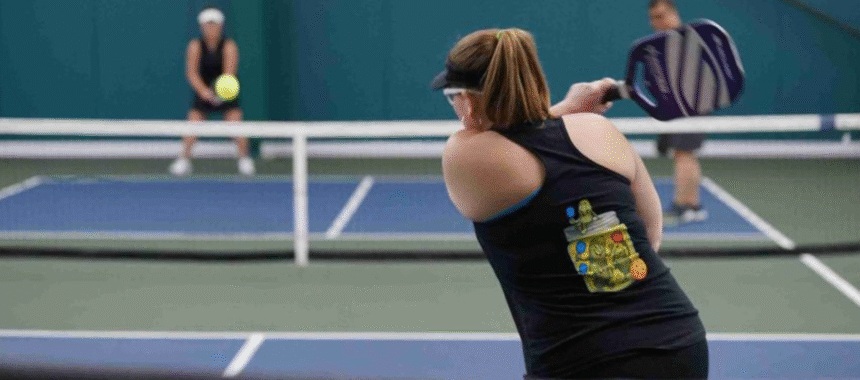
Learning how to stay focused during a pickleball match is the difference between players who choke under pressure and players who thrive. These 5 in-game mental techniques give you the tools to stay locked in from the first serve to the final point.
If you can’t stay focused during a pickleball match, your technique doesn’t matter.
You can drill your third shot drop for hours and still crumble the moment a match gets tight.
The mental side of pickleball is real, it’s trainable, and most players completely ignore it.
Here’s what separates players who bounce back from a 3-point deficit and players who spiral: not their paddle, not their footwork. Their head.
These five techniques are what competitive players actually use to stay sharp in-game, not just tips for practice sessions.
Whether you’re grinding singles or running doubles strategy, mental focus is the skill that holds everything else together.
Love pickleball? Then you’ll love our free newsletter. We send the latest news, tips, and highlights for free each week.
Why Staying Mentally Focused in a Pickleball Match Is So Hard
The short answer: pickleball is fast, points are short, and momentum swings without warning.
A 2024 study published in the Journal of Sport & Exercise Psychology found that attentional focus in racquet sports drops significantly after consecutive point losses, making mental recovery a genuine performance skill, not a soft one.
In pickleball specifically, the rally structure means you’re re-engaging focus every 5 to 10 seconds. That’s exhausting if you don’t have a system for it.
The pressure zone in pickleball is real. When you hit a bad shot, your brain floods with self-critique.
By the time the next point starts, you’re still processing the last one. That’s the mental gap most players never fix.
This isn’t about “just staying positive.” It’s about having repeatable, in-game routines that keep your attention where it belongs: the next ball.
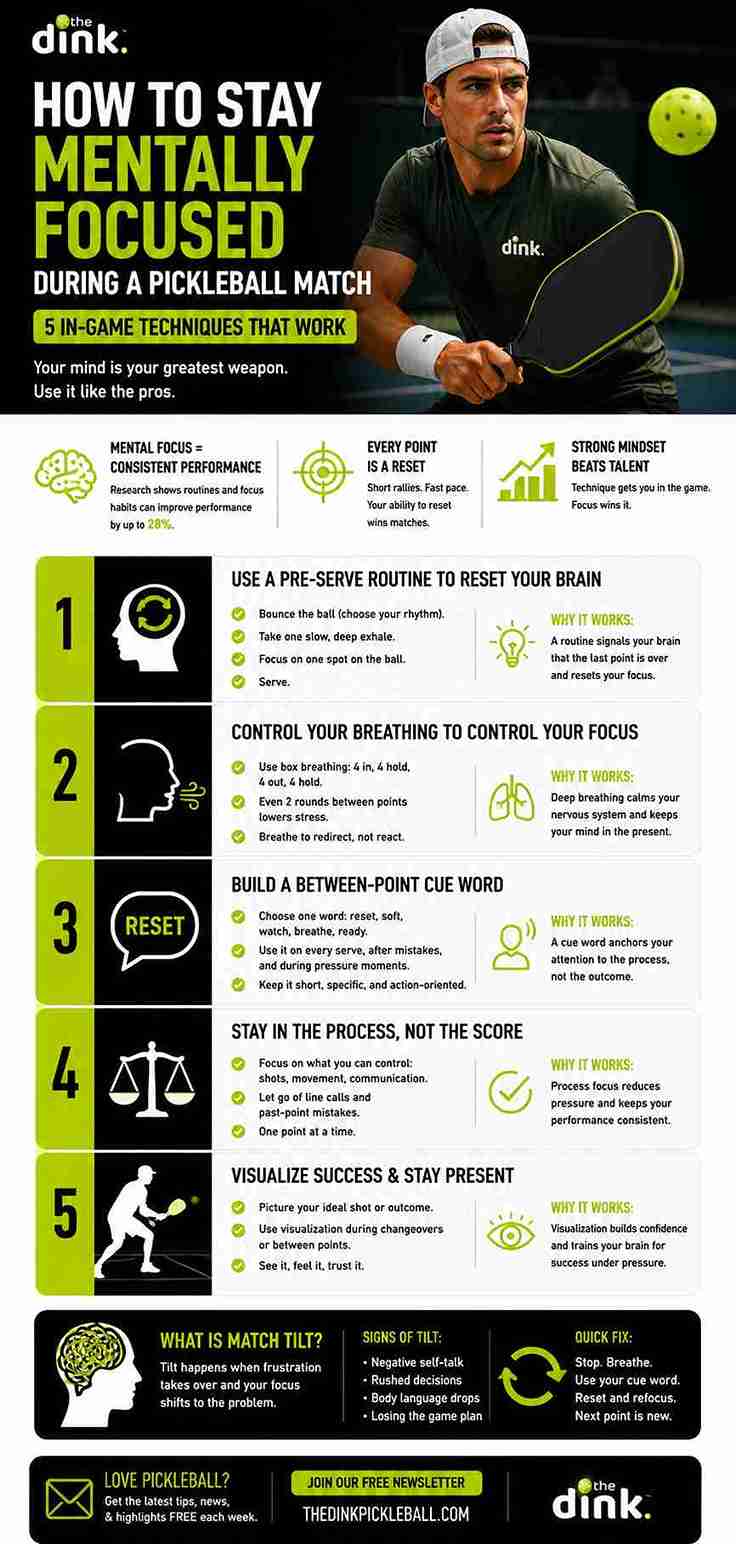
Technique 1: Use a Pre-Serve Routine to Reset Your Brain
The fastest way to stay focused during a pickleball match is to give your brain a reset trigger between every single point.
This is called a pre-performance routine, and it’s one of the most research-backed interventions in sports psychology.
A 2025 meta-analysis in the International Journal of Sport Psychology found that consistent pre-performance routines reduced attentional errors by up to 28% in competitive racquet sport athletes.
That’s not a small number.
Here’s what a real pre-serve routine looks like in pickleball:
- Bounce the ball twice (or once, pick one and stick with it).
- Take one slow, deliberate exhale through your mouth.
- Focus your eyes on a single spot on the ball before you serve.
- Go.
That’s it. The goal isn’t to add a ritual, it’s to signal your nervous system that the last point is over.
It works because it forces a momentary break in the mental loop that follows a bad shot.
Solo drills are a great place to build this into your muscle memory before you ever step into a match.
The pros use this. Watch Ben Johns before any serve sequence. He’s not just standing there. He’s resetting.
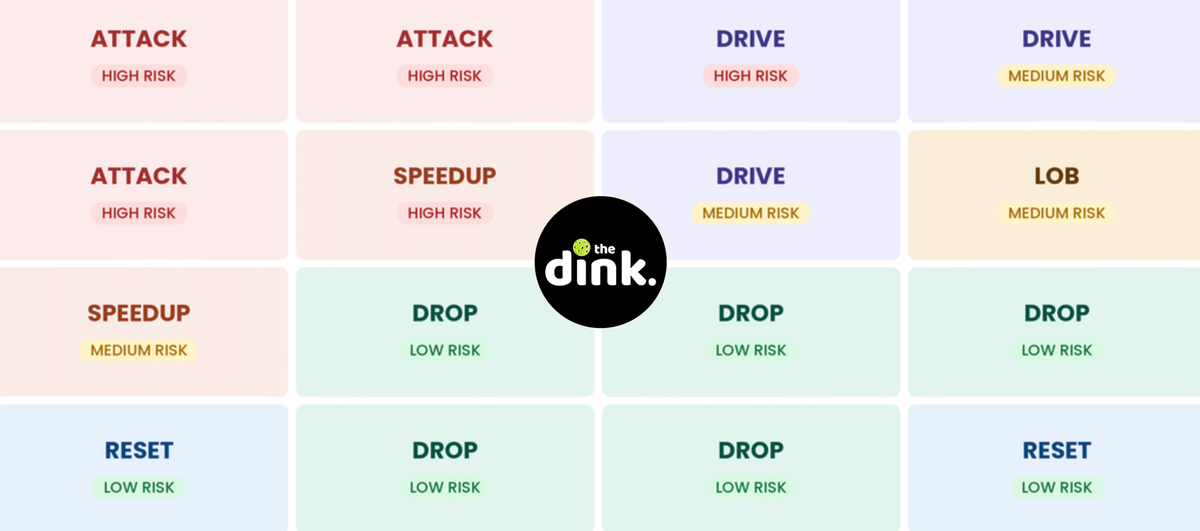
Decision Matrix: When to Attack or Reset in Pickleball
Pickleball is really all about two key factors: your court positioning and the height of the ball. This matrix decodes the game for you.
Technique 2: Control Your Breathing to Control Your Focus
Controlled breathing is the most underused mental tool in pickleball. Not because players don’t know about it, because they forget to do it when it actually matters.
When you lose two or three points in a row, your heart rate spikes and your breathing gets shallow.
That physiological change directly narrows your attentional focus, making you more reactive and less strategic.
Research from the NIH confirms that diaphragmatic breathing activates the parasympathetic nervous system within 30 to 60 seconds, measurably reducing competitive anxiety in sport settings.
The technique that works best for in-match use: box breathing. Four counts in through the nose, hold for four, out for four, hold for four.
You don’t need to run the full cycle mid-match. Even two rounds between points gives your brain a literal reset.
You can practice this off the court.
Try pairing cold plunge recovery sessions with box breathing, the combination trains your nervous system to stay calm under physical stress, which transfers to match pressure faster than most people realize.
Proper pickleball nutrition also plays a role here: blood sugar crashes mid-match accelerate mental fatigue faster than most players expect.
One more thing: breathing is a redirect. The moment you feel tilt coming, use it.
💡
Technique 3: Build a Between-Point Mental Cue Word
A cue word (sometimes called a “trigger word” in sports psych) is a single word you say internally to snap your attention back to process instead of outcome.
Good cue words for pickleball are short, specific, and action-oriented. Think: reset, soft, watch, breathe, or ready.
Not calm down or don’t miss, those are outcome-focused and they backfire.
The science here is solid.
A 2025 study published in Psychology of Sport and Exercise found that instructional cue words improved shot consistency in racquet sports by directing attention to movement cues rather than outcome anxiety.
They work because your working memory can only hold so much at once. Give it something specific and it has less room to catastrophize.
Here’s how to build this into your game: pick one word before you ever start a match. Use it every time you walk to the baseline to receive serve.
Use it after a mistake. Over time, it becomes an automatic redirect.
Focusing on your strengths rather than your weaknesses becomes much easier when you’ve got that internal anchor.
And if you’re practicing dinking technique in drills, that’s the right time to rehearse your cue word so it fires automatically when match nerves arrive.
Reset is the most popular for a reason. It’s short, it’s directive, and it works for every shot type.
Mental Warfare: What Elite 6.0 Pickleball Players Think During Every Dink
What separates good from great in pickleball is the split-second mental shift that happens the moment the ball leaves the paddle
What Is “Match Tilt”, and Why It Kills Your Focus?
Before the next two techniques, it helps to name the specific mental state that wrecks most recreational pickleball players: match tilt.
Match tilt is borrowed from poker terminology.
It describes the state where a bad outcome (a shanked dink, a net cord, a missed overhead) triggers an emotional spiral that distorts your decision-making for the next several points.
You start going for hero shots. You get passive. You argue with yourself between points.
The mistake you didn’t know you were making in most recreational games isn’t technical, it’s allowing match tilt to run unchecked. Tilt is normal.
Going unaddressed is the problem.
If you’ve ever watched how doubles strategy shifts mid-match, you’ve seen tilt happen at the team level, one bad reset leads to a full pattern breakdown if neither player has a mental anchor.
Techniques 4 and 5 are specifically designed to interrupt tilt patterns before they compound.
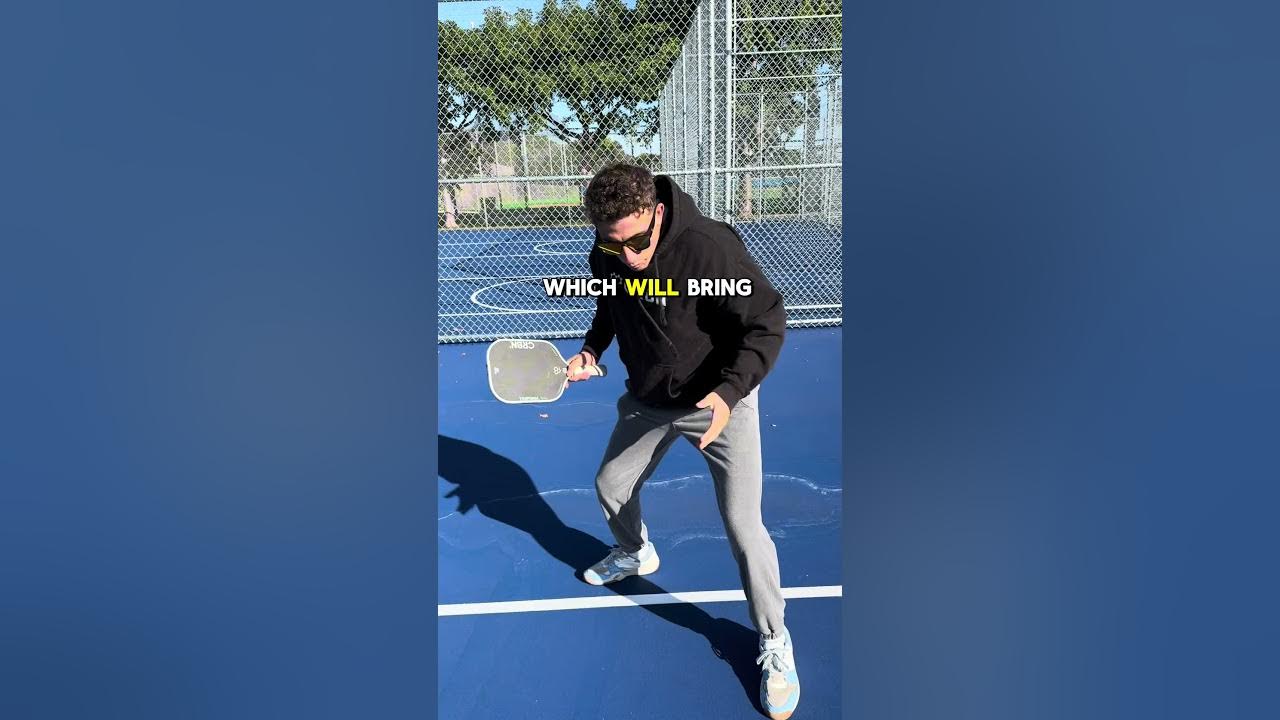
3 Mistakes Killing Your Pickleball Serve Power
Most pickleball players are unknowingly sabotaging their pickleball serve power with three critical mistakes. Fix your shoulders, hips, and ball placement to generate explosive power on every serve.
Technique 4: Use a “Focus Anchor” at the Kitchen Line
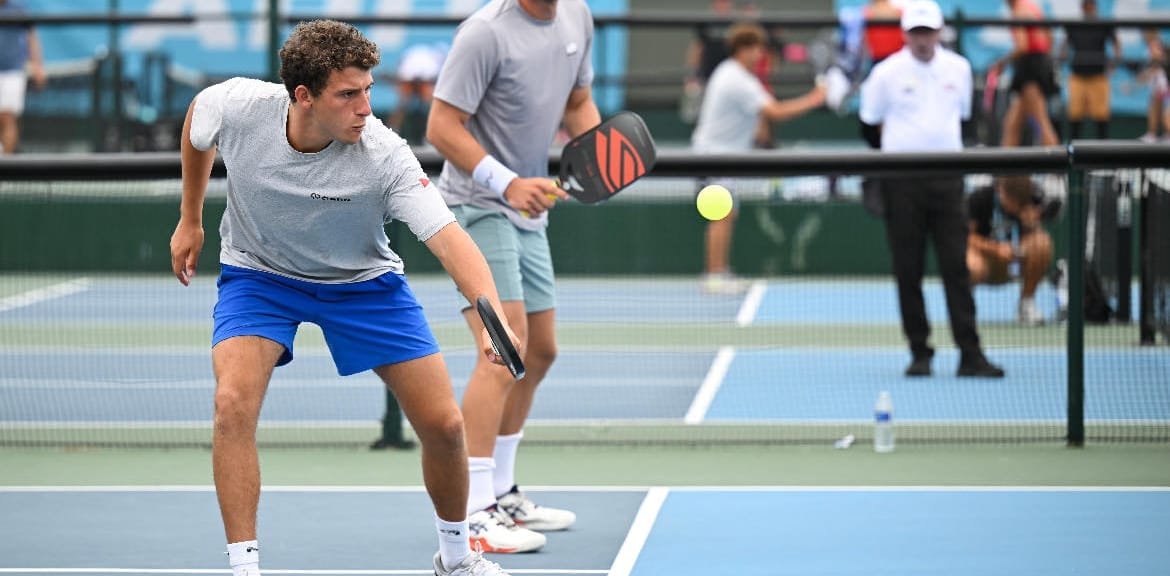
When you’re at the kitchen line, your focus anchor is simple: watch the ball, not your opponent.
Sounds obvious. It almost never happens in high-pressure moments.
When you’re serving at 9-10 in a close game, most players start watching where their opponent is standing, what shot they might hit, and whether they’ll speed up.
That’s where focus breaks down, your attention shifts from the ball to an imagined outcome.
A focus anchor is a behavioral rule that keeps your attention locked on a specific cue. At the kitchen, that cue is the ball coming off your opponent’s paddle face.
Track the contact point. Every single time.
It gives your eyes, and therefore your brain, something concrete to attach to instead of floating into anticipation mode.
This technique connects directly to becoming unattackable in pickleball.
Players who stay disciplined in dink rallies aren’t just more consistent technically, they’re more focused. The two things feed each other.
The same principle applies to your return of serve. Watch the ball hit the paddle, not the flight path.
The flight path follows from that contact point; if you track it from the start, you stop guessing.
The same goes for resetting at the kitchen, players who get attacked and lose focus on the ball end up popping the ball up, not because they lack the shot, but because their eyes drifted to their opponent’s body.
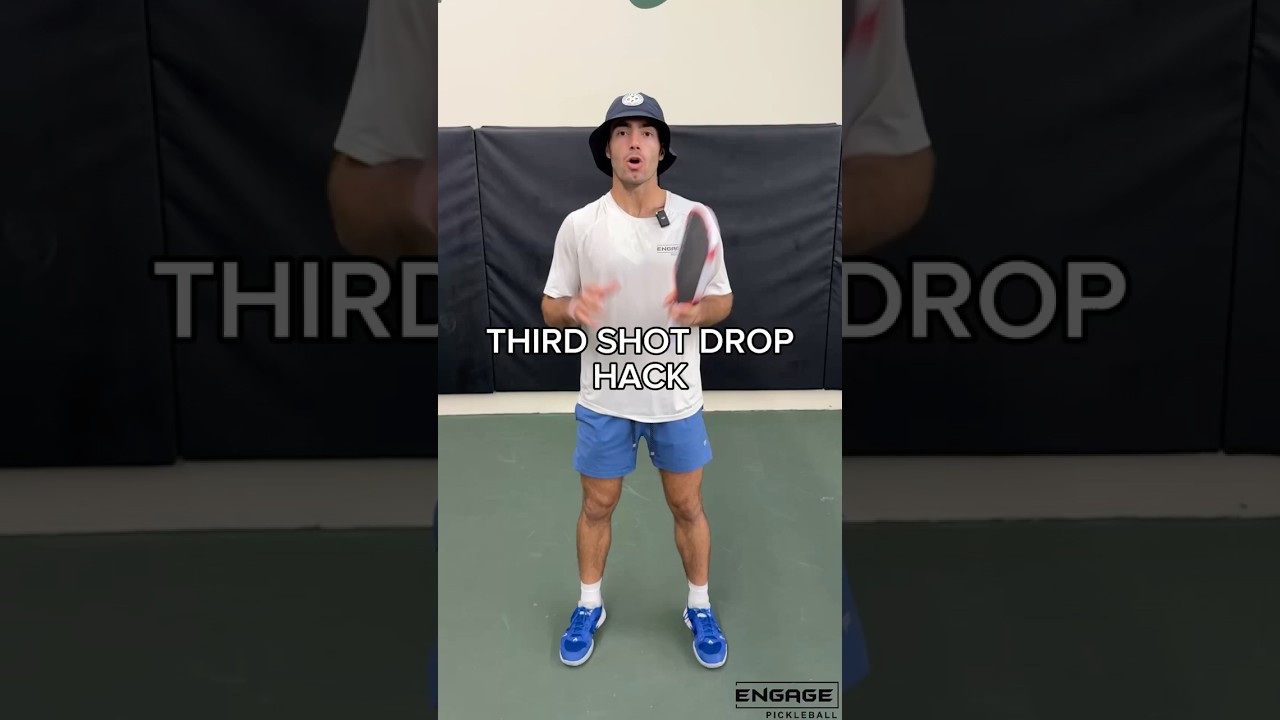
Master the Third Shot Drop in Pickleball
The third shot drop is one of pickleball’s most critical shots, and most players are making a fundamental mistake. Richard from Engage Pickleball reveals the contact point hack that will transform your consistency and get you to the kitchen line every time.
Technique 5: Reframe Mistakes in Real Time
The final technique for staying mentally focused during a pickleball match is the hardest to do, and the most important.
Every time you make an error, give yourself a maximum of three seconds to process it.
Then find one adjustable detail to carry into the next point.
Not “that was terrible.” Not “I keep making this same mistake.” Those are closed loops, there’s no action attached.
The reframe is: I dropped my elbow on that backhand dink. Next time, keep it up. That’s a specific, correctable detail. Your brain can work with it.
This is what champion mindset building actually looks like at the recreational level. It’s not pretending mistakes didn’t happen.
It’s converting frustration into information.
Even the second part of that mindset series makes the same point: reframing is a repeatable skill, not a personality trait.
The three-second rule matters because it forces urgency. You don’t have the luxury of a tennis changeover.
Pickleball keeps moving. You’ve got to process and redirect, fast.
Pairing this with your cue word from Technique 3 gives you a complete loop: mistake happens, cue word fires, one technical adjustment identified, next point starts fresh.
Building out a regular practice routine is where this loop gets burned in so it runs automatically when match pressure hits.
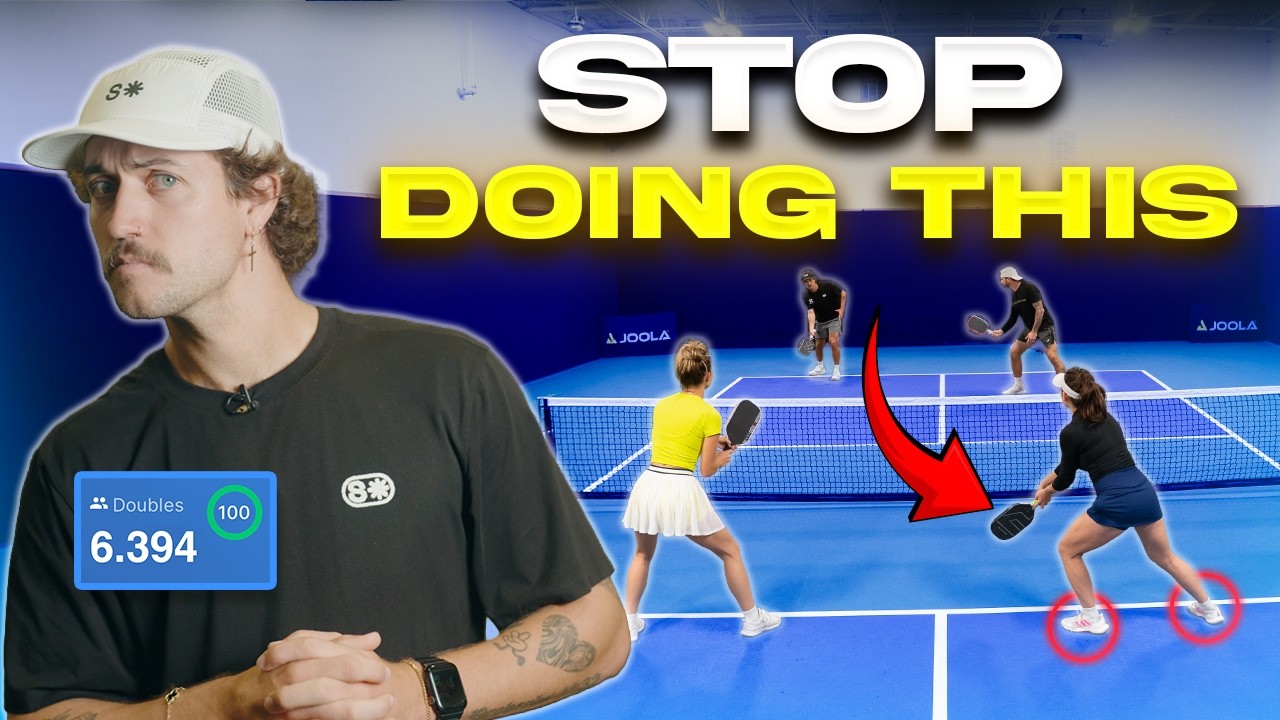
7 Pickleball Mistakes Beginners Make Without Realizing
Most beginners struggle not because they lack power, but because they repeat the same pickleball mistakes over and over without realizing it. Pro player Michael Loyd reveals the seven habits quietly holding players back and exactly how to fix them.
Key Takeaways
- Mental focus is a skill, not a personality trait, it can be trained and improved like any shot.
- A pre-serve routine gives your brain a reset trigger between every point.
- Controlled breathing (box breathing, specifically) interrupts the physiological stress response within 60 seconds.
- A cue word redirects attention from outcome anxiety to process in the middle of a rally.
- A focus anchor at the kitchen line keeps your eyes, and brain, on the ball, not on outcomes.
- Reframing mistakes in real time with a three-second rule turns errors into adjustments, not spirals.
💡
Frequently Asked Questions
How do I stay focused during a pickleball match when I’m losing?
When you’re down in a match, the biggest mental mistake is thinking about the score instead of the next shot. Shift your attention to one specific, controllable process cue, your breath, your footwork, or your contact point. Use your cue word after every point loss to create a hard mental reset. Staying focused during a pickleball match when you’re losing is about narrowing your attention window, not broadening it.
What is the best breathing technique to use during a pickleball match?
Box breathing is the most effective technique for in-match use. Inhale for four counts, hold for four, exhale for four, hold for four. Even one or two rounds between service sequences measurably lowers your heart rate and reduces competitive anxiety. You don’t need a full mindfulness practice, just two deliberate breaths before stepping to the line can shift your mental state.
How long does it take to build mental toughness for pickleball?
Most players notice a meaningful difference in 4 to 6 weeks of consistent practice, specifically when they rehearse mental routines during drills, not just matches. The key is repetition in low-stakes settings so the routine becomes automatic when pressure arrives. Start by adding a pre-serve routine to every practice session, then layer in your cue word and breathing techniques over time.
Can mental focus techniques help in doubles pickleball too?
Yes, and in some ways it’s more critical in doubles because you have a partner to manage alongside your own mental state. Focus anchor techniques (tracking the ball off your opponent’s paddle) are just as effective. The cue word and three-second mistake reframe are also valuable for keeping communication with your partner clean rather than getting pulled into frustration after a lost point.
What mental mistakes do recreational pickleball players make most often?
The most common mental mistakes are: fixating on score instead of process, replaying the last bad shot instead of preparing for the next, and going for overly aggressive shots when nervous. All three are symptoms of the same underlying issue: attention shifted to outcome rather than the immediate, controllable action in front of you. Building a consistent between-point routine is the single most effective fix for all three.
Nguồn: thedinkpickleball