Pickleball court measurements follow exact USA Pickleball standards, with a total playing surface of 44 feet long by 20 feet wide. This guide breaks down every line, zone, and dimension so you never second-guess what’s in bounds or out.
Pickleball court measurements aren’t complicated, but they matter more than most players realize.
The distance from the kitchen line to the net, the width of the sidelines, the exact height of the net at center and at the posts: all of it shapes how the game is played at every level, from backyard sessions to USA Pickleball sanctioned events.
Get the numbers wrong and you’re not really playing pickleball. You’re playing something close.
This guide covers every dimension you need, with no filler and no guesswork.
Whether you’re building a court, teaching a new player, or just tired of second-guessing a ball that landed near the line, this is your definitive reference.
Love pickleball? Then you’ll love our free newsletter. We send the latest news, tips, and highlights for free each week.
What Are the Standard Pickleball Court Measurements?
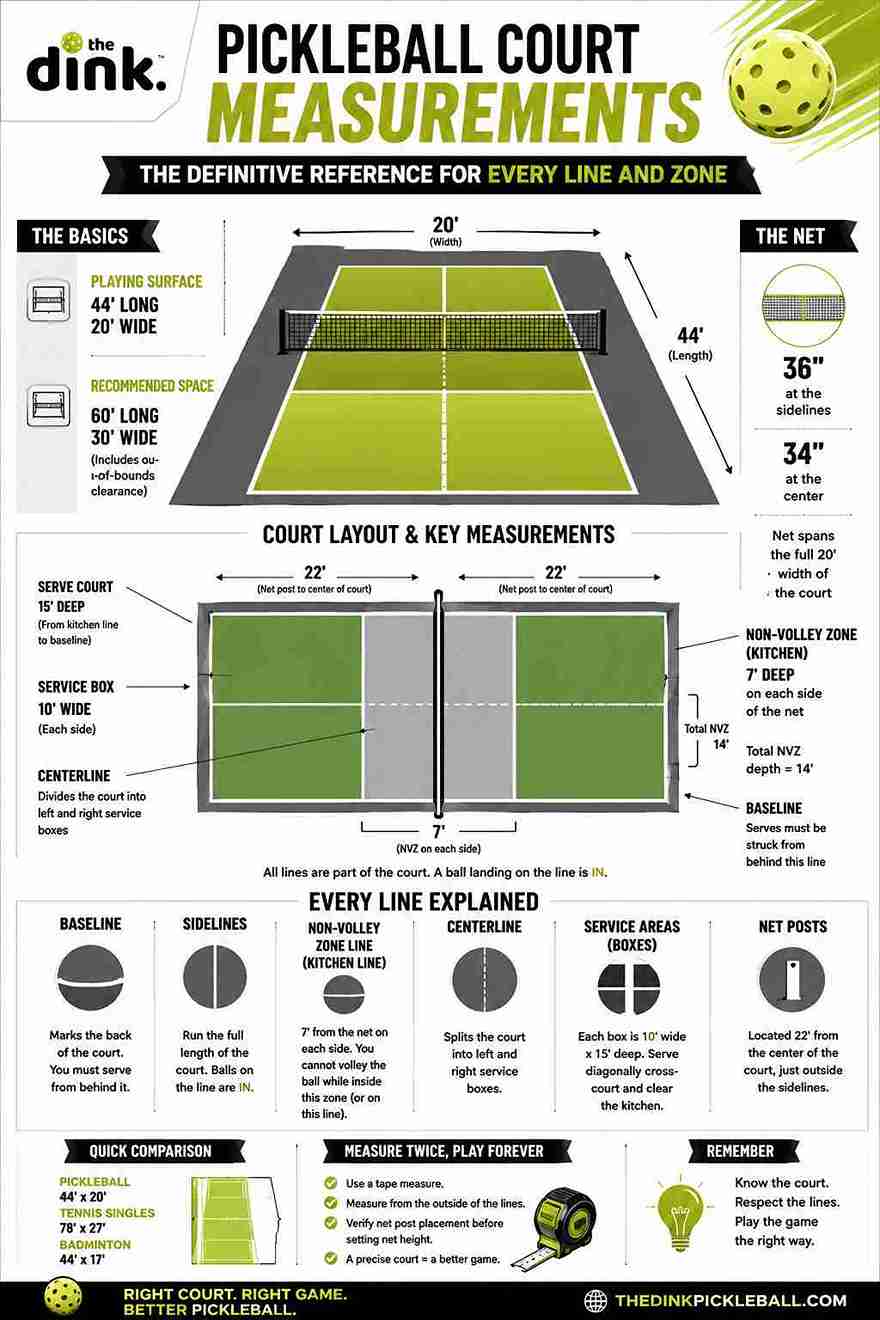
A standard pickleball court is 44 feet long and 20 feet wide.
That’s the official playing surface as defined by the USA Pickleball Official Rulebook (2025), which governs all sanctioned play in the United States.
Those are the same dimensions whether you’re playing singles or doubles. The full court doesn’t change based on how many people are on each side.
What changes is how the space gets used.
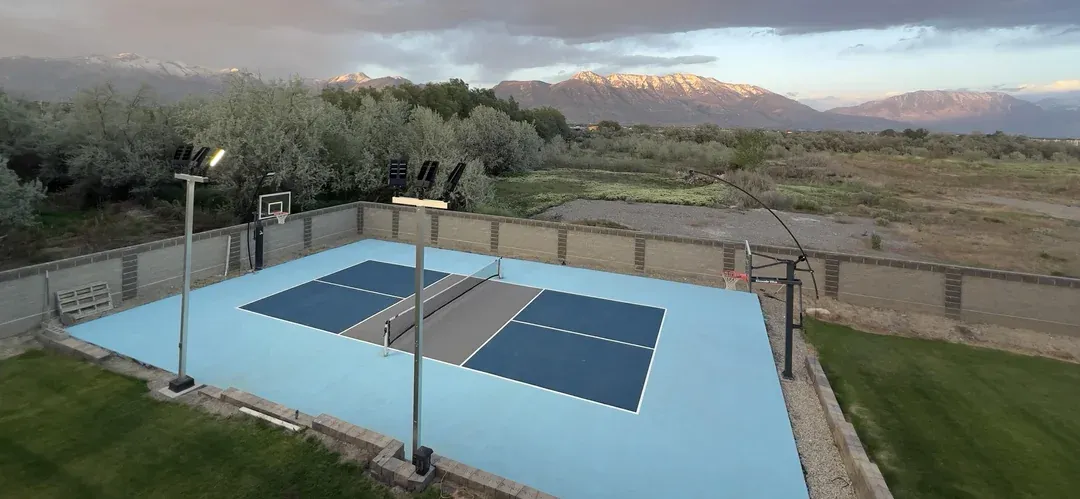
The total recommended space including out-of-bounds clearance is 60 feet long by 30 feet wide.
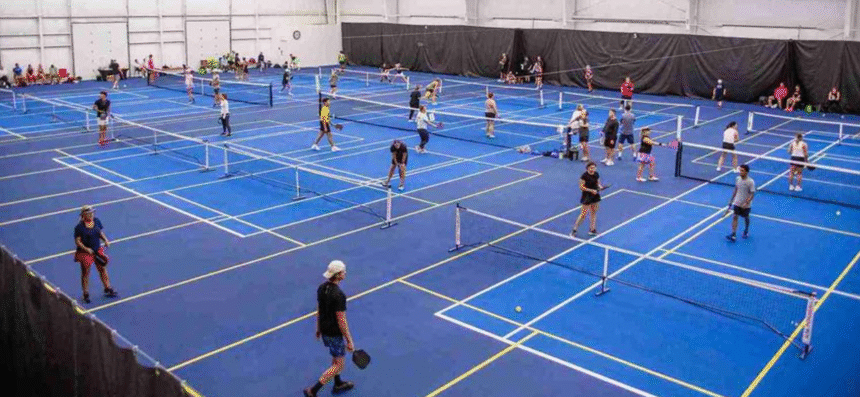
That buffer matters on hard courts where players are sprinting for wide balls. Rec centers and dedicated pickleball clubs usually build to that spec.
Converted tennis courts often fall short, which is why those courts can feel cramped at the sidelines.
The Kitchen: Pickleball’s Most Misunderstood Zone
The kitchen, formally called the non-volley zone (NVZ), runs the full width of the court on both sides of the net. It extends 7 feet from the net on each side, making the total NVZ depth 14 feet between the two kitchen lines.
Here’s the thing: the kitchen line itself is in the non-volley zone. Step on it while volleying and it’s a fault.
That catches players constantly. The rule isn’t just about being inside the zone; it includes that line.
If you want to understand why kitchen positioning changes everything at higher levels of play, check out this breakdown of how to position yourself at the kitchen.
The geometry of pickleball court measurements makes the kitchen the most strategically dense 7 feet in the sport.
💡
How Does the Net Factor Into Pickleball Court Dimensions?
The net runs the full 20-foot width of the court and sits at specific heights at two points: 36 inches at the sideline posts and 34 inches at the center.
That 2-inch sag at center isn’t incidental. It’s part of the spec.
Net posts are placed 22 feet from the center of the court, slightly outside the sideline on each side. The posts themselves sit outside the playing area.
This is a detail that trips up a lot of DIY court builds. People measure to the sideline, not to the post position.
The result is a net that’s either too loose or set at the wrong height. If you’re setting up a court, always verify the post placement first, then tension accordingly.
According to USA Pickleball’s equipment standards, the net must maintain that 34-inch center height under tension during play.
Understanding your service rules depends in part on understanding how the net creates different flight paths from the baseline.
Pickleball Net Height: Official Measurements Explained
Pickleball net height is 34 inches at the center and 36 inches at the sideline posts, and that 2-inch difference shapes every strategic decision you make on the court. Understanding the official measurements gives you an edge whether you’re setting up a court or rethinking your shot selection.

Pickleball Court Lines: What Each One Means
Every line on a pickleball court has a name and a specific function. Most players know the big ones. Here’s the complete list:
- Baseline: The line running parallel to the net at each end of the court. Serves must be struck from behind the baseline. The baseline sits at the 44-foot boundary of the playing surface.
- Sidelines: The two lines running the length of the court on each side, spanning that full 20-foot width. A ball that lands on a sideline is in. This is a common source of line call disputes; the line is always in.
- Non-Volley Zone Line (Kitchen Line): Runs parallel to the net at 7 feet on each side. As noted above: standing on this line while volleying is a fault.
- Centerline: Divides the court from the kitchen line to the baseline, splitting the court into two equal service boxes on each side. The centerline creates the left and right service areas for each player.
- Service Areas: Each side has two service boxes. They’re each 10 feet wide (half of the 20-foot court width) and 15 feet deep (the distance from the kitchen line to the baseline). The serve must land in the diagonal service box and clear the kitchen entirely.
For a deeper breakdown of how lines affect the serve in practice, this look at serving strategies near the kitchen is worth your time.
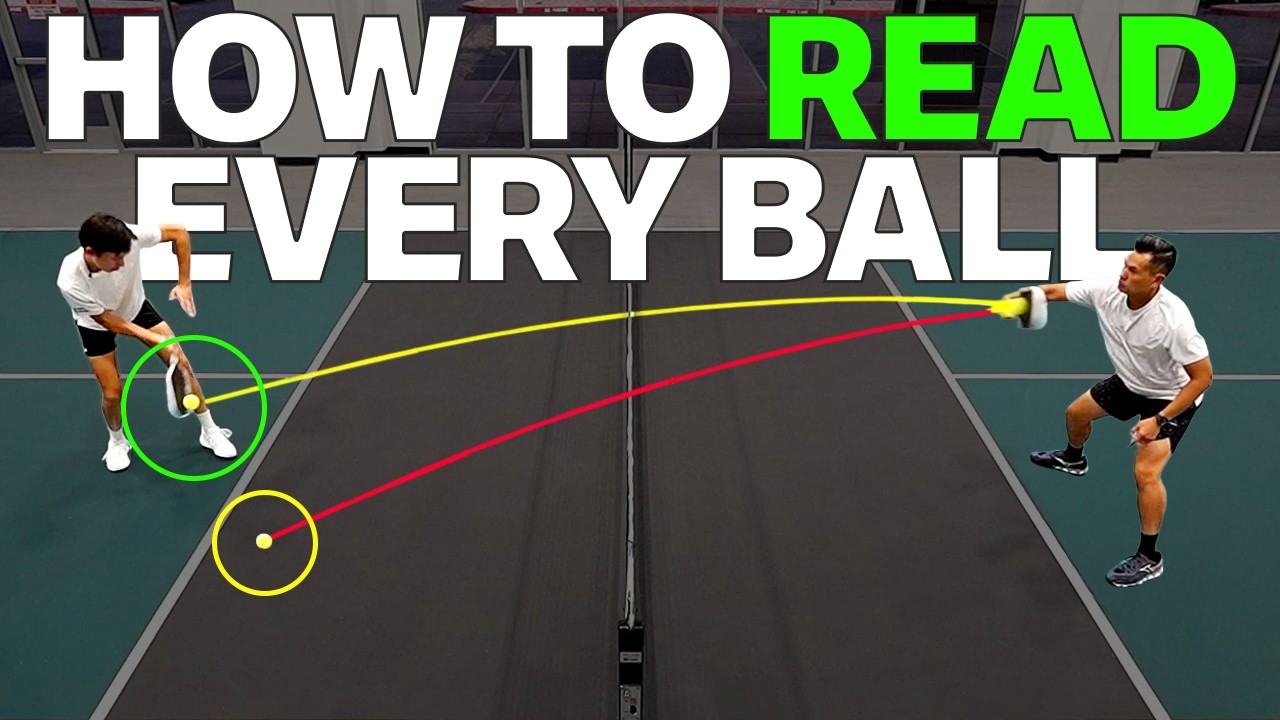
Recognize Your Court Position to Hit the Right Pickleball Shot Every Time
Hitting harder or faster won’t fix your game if you’re hitting the wrong shot at the wrong time. Learn to read the court, understand your position, and choose your shots accordingly.
How Do Pickleball Court Measurements Compare to Other Sports?
Here’s a quick calibration for anyone coming from tennis or badminton.
A standard tennis singles court is 78 feet long and 27 feet wide. A doubles tennis court runs to 36 feet wide.
Pickleball’s 44×20 footprint is roughly one-third the area of a full tennis court.
This is why four pickleball courts can fit inside one tennis court layout, though the conversion has its own complications.
Badminton singles runs 44 feet by 17 feet. Close in length to pickleball, but narrower.
The net height in badminton (5 feet at center) is significantly taller than pickleball’s 34 inches.
Ping pong, for what it’s worth, is played on a 9-foot table. The jump from ping pong to pickleball is dramatic in terms of footwork demands.
These comparisons matter practically. If you’re converting a space, understanding the differences helps you avoid the most common mistakes.
Pickleball construction has become a serious industry, partly because the sport fits into spaces that don’t easily accommodate larger court sports.
Pickleball Court Dimensions: Every Measurement You Need
Standard pickleball courts are 20′ x 44′. Each side of the net features a 7′ non-volley zone, commonly known as the “kitchen.”
Does the Court Size Change for Singles Play?
No. Pickleball court dimensions are identical for singles and doubles. The full 44×20 surface is used in both formats.
This is one of the features that makes singles pickleball extremely demanding physically. You’re covering the entire 20-foot width on your own.
In doubles, each player is typically responsible for roughly 10 feet of court. In singles, that doubles.
Footwork and court positioning become even more critical when the court dimensions don’t scale down with the player count.
Pickleball Singles Strategy: Court, Serve & Fitness
A strong pickleball singles strategy separates players who grind out wins from those who run out of gas after two sets. This guide breaks down the court coverage principles, serve patterns, and fitness demands every singles player needs to compete.
What About Indoor vs. Outdoor Pickleball Court Measurements?
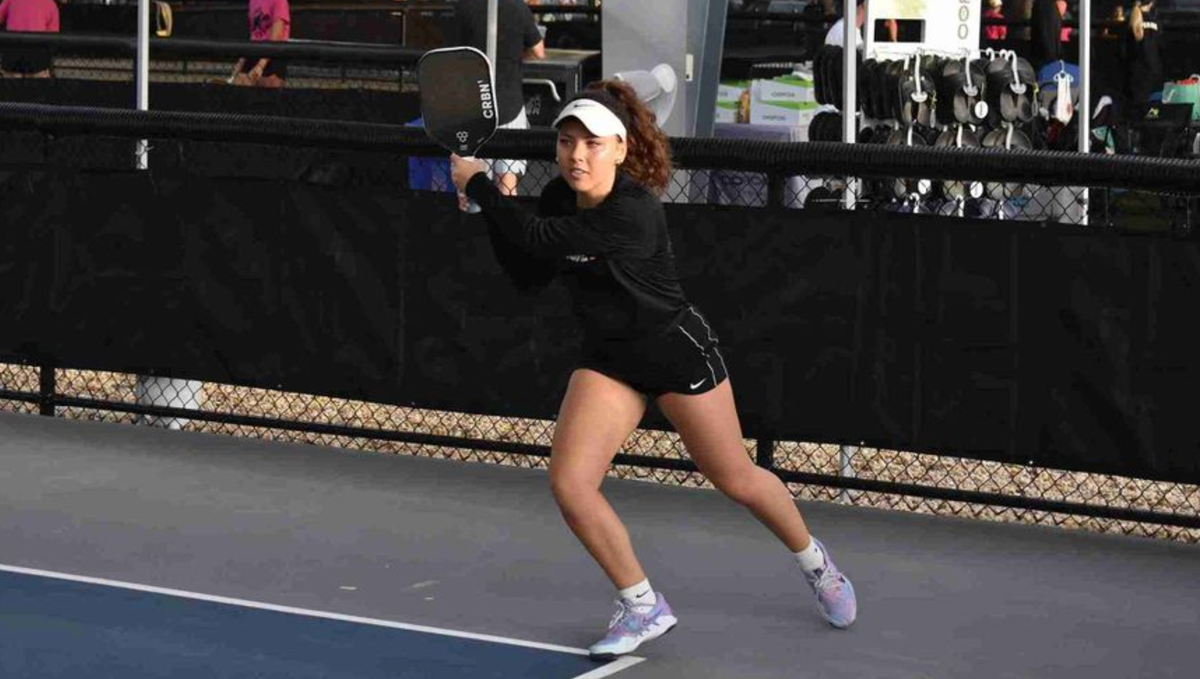
Same dimensions. Indoor and outdoor pickleball courts share identical measurements as specified by USA Pickleball.
The differences are environmental, not dimensional.
Outdoor courts use thicker, slower balls (Franklin X-40 or similar) that are designed to handle wind and temperature variation.
Indoor balls tend to be lighter and faster, with smaller holes.
The court surface itself also differs: outdoor courts are typically asphalt or concrete with an acrylic coating, while indoor facilities often use wood or sport tile.
Surface type affects ball bounce more than most players expect.
A well-maintained indoor court tends to produce a more consistent bounce than an outdoor court that’s seen weather and wear.
Neither surface changes the measurement spec.
If you’re looking to find a court near you, our San Diego court guide and the Austin playing guide are good models for what to look for in a quality facility.
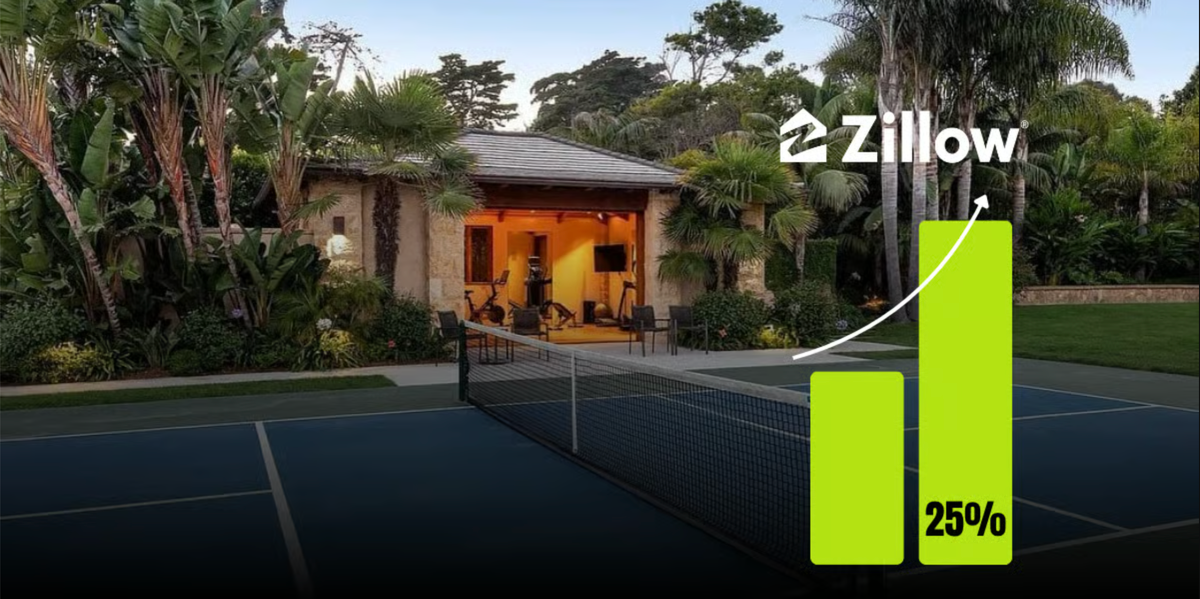
Pickleball Courts Are the New Man Caves, Zillow Reports — and Listings are Up 25%
Zillow’s 2026 Home Trends Report captures the next hot trend in home design. Now more than ever, pickleball courts are in.
Why Do Pickleball Court Measurements Matter for Your Game?
Understanding the exact pickleball court size changes how you practice and compete. A few specific reasons:
- Third shot targeting: The kitchen line sits 7 feet from the net. Your third shot drop must clear the net (at its lowest point, 34 inches at center) and land before or on that line. Knowing that exact geometry helps you understand the margin for error on every drop attempt. For more on the third shot drop’s mechanical demands, see this breakdown of third shot mechanics.
- Serve depth: The service box is 15 feet deep, from kitchen line to baseline. A deep serve lands near the baseline, pushing your opponent back. A short serve lands closer to the kitchen line and gives them an easy approach. Understanding those 15 feet helps you target your serve deliberately.
- Doubles court coverage: At 10 feet per player in doubles, covering your half of the court requires fast, efficient movement. Knowing your exact zone helps you avoid both poaching too aggressively and leaving gaps in coverage.
- Erne and ATP opportunities: The ATP (Around the Post) shot and the Erne are possible because the rules allow you to go around or over the net post outside the court boundary. Understanding where the sideline ends and where the post sits makes these shots easier to visualize.
Pickleball Shot Selection: Ball Height & Court Positioning
Advanced pickleball means constantly analyzing the height of the ball and the court positioning off all four players in real time – and keeping this one rule sacred: just because you can hit a more aggressive shot doesn’t mean you should
Key Takeaways
- A standard pickleball court is 44 feet long by 20 feet wide
- The non-volley zone (kitchen) extends 7 feet from the net on each side
- The net is 36 inches at the posts and 34 inches at center
- The kitchen line is part of the non-volley zone; standing on it while volleying is a fault
- All sideline and baseline lines are in bounds when the ball lands on them
- Court dimensions are identical for singles and doubles, and for indoor and outdoor play
- Total recommended court space including clearance is 60 feet by 30 feet
💡
Frequently Asked Questions
What are the official pickleball court measurements?
A regulation pickleball court is 44 feet long and 20 feet wide, as specified by USA Pickleball. The non-volley zone extends 7 feet from the net on each side. Net height is 36 inches at the posts and 34 inches at center. These dimensions apply to all sanctioned play in the United States and internationally through the International Federation of Pickleball.
How big is the pickleball kitchen, and why does it matter?
The kitchen, or non-volley zone, is 7 feet deep on each side of the net, running the full 20-foot width of the court. It matters because you cannot volley the ball while standing in or on the kitchen line. This rule forces players to let the ball bounce before returning from inside the zone, which is why kitchen strategy is at the center of competitive pickleball.
Is a pickleball court the same size as a badminton court?
They’re close in length but not identical. A pickleball court is 44 feet long and 20 feet wide. A badminton singles court is 44 feet long and 17 feet wide. The net heights differ significantly: pickleball nets are 34 inches at center, while badminton nets are 5 feet. The two sports feel very different to play despite the similar length.
Do pickleball court measurements change for singles vs. doubles?
No. The court is the same size for both formats: 44 feet by 20 feet. In singles, each player covers the full 20-foot width independently, which makes singles play significantly more demanding physically. The rules for kitchen violations, line calls, and serving are consistent across both formats.
How much space do you need to build a pickleball court?
The minimum playing surface is 44 feet by 20 feet, but the recommended total space is 60 feet by 30 feet to allow safe out-of-bounds clearance. For outdoor construction, you also need to account for proper drainage, surface type (concrete or asphalt with acrylic coating), and net post placement. Many facilities consult USA Pickleball’s facility construction resources before breaking ground.
Nguồn: thedinkpickleball