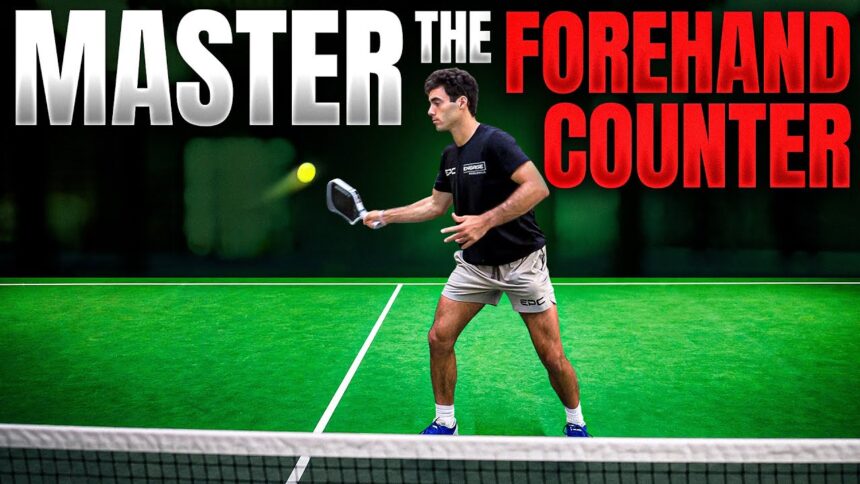
The forehand counter is one of the most challenging shots in pickleball, especially for continental grip players. Master this essential skill with proven technique and mechanics that will transform your hands battles at the kitchen line.
Most pickleball players struggle with the forehand counter because they swing too big, panic, or don’t understand how to absorb and redirect pace.
In today’s faster game, mastering this shot is one of the biggest keys to winning firefights and speeding up the game on your terms.
If you’re someone who pops up forehand counters or loses control in fast hands battles, you’re not alone.
The good news? There’s a technical fix that can transform your game.
Love pickleball? Then you’ll love our free newsletter. We send the latest news, tips, and highlights for free each week.
Why the Forehand Counter Is So Tough for Continental Grip Players
Here’s the thing: if you’re using an eastern or semi-western grip, the forehand counter feels natural.
Your paddle face is already tilted, which means you can swing through the ball with control. You can even snap your wrist and still land it in the court.
Players with these grips love the forehand counter because it’s forgiving.
But if you’re using a continental grip at the net, which most modern pickleball players should be, the forehand counter becomes a completely different animal.
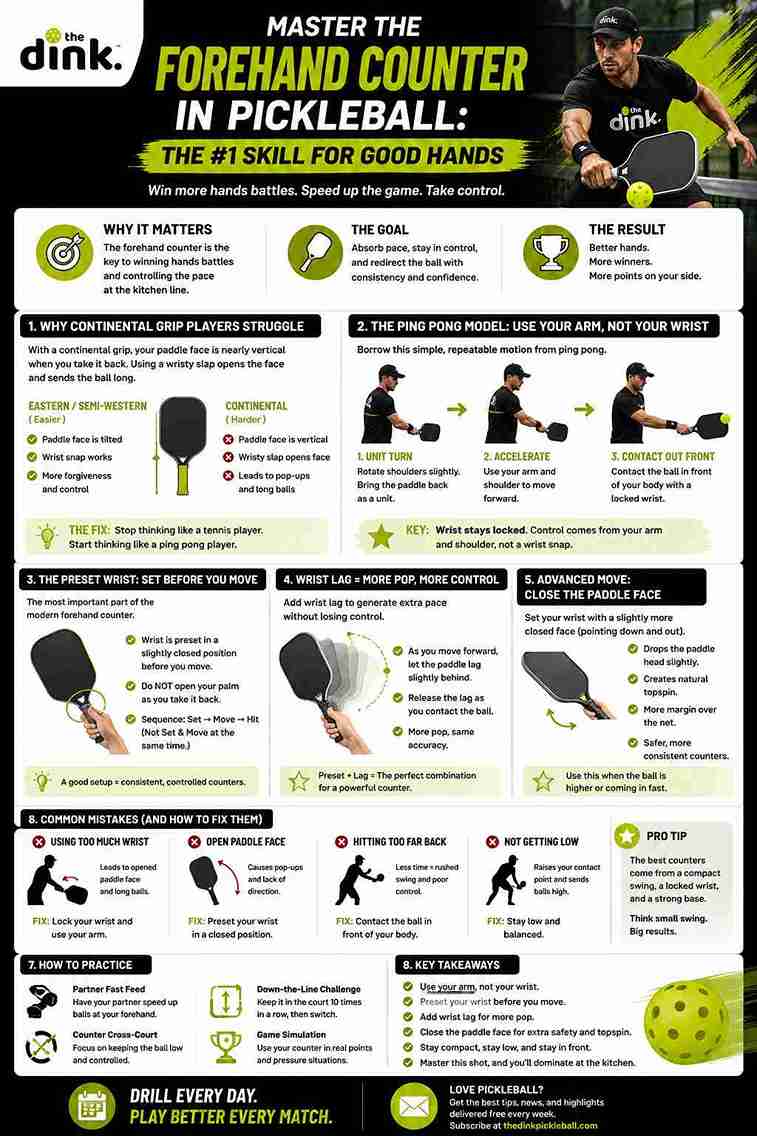
When you take your paddle back with a continental grip, your paddle face is nearly vertical.
If you try to slap the ball with your wrist, the face opens up, the ball flies long, and you lose control.
This is why so many continental grip players struggle with this shot.
APP pro Richard Livornese explains that the issue isn’t your grip itself.
It’s that you’re trying to use a wrist-based motion with a grip that doesn’t support it.
The solution? Stop thinking like a tennis player and start thinking like a ping pong player.
Understanding what grip works best for your shots is the first step to unlocking a reliable forehand counter.
The Ping Pong Forehand Model: Your Secret Weapon for the Forehand Counter
The key to mastering the forehand counter is borrowing mechanics from ping pong.
In ping pong, players use their arm and shoulder to generate power, not their wrist.
This approach works beautifully in pickleball, especially at the net where space is tight and timing is everything.
Here’s how it works:
- Instead of taking your paddle back with a slappy wrist motion, you’re going to use a unit turn.
- Your shoulders rotate slightly, your arm comes back, and your wrist is already preset before you even move.
- Then, as the ball comes toward you, you simply accelerate through it with your arm.
The wrist stays locked. This is the opposite of what most players try to do.
The beauty of this approach is consistency.
When you rely on arm motion instead of wrist snap, you can time the shot much more easily, even when your opponent is hitting fast.
You’re not trying to time up a wrist slap with a continental grip, which is nearly impossible.
Instead, you’re using a simple, repeatable motion that works whether the ball is high, middle, or low.
Richard demonstrates this by showing how he can counter from different positions on the court.
Even when he’s pushed back or when the ball is dead, he can still execute the shot because the mechanics are so compact and controlled.
This is what separates the pros from everyone else.
If you want to see how pros use ping pong principles to dominate at the net, the concepts transfer directly to your forehand counter game.
💡
The Preset Wrist: The Foundation of Forehand Counter Control
Before you even think about swinging, you need to understand the preset wrist. This is the single most important element of the modern forehand counter.
When you take your paddle back, your wrist isn’t neutral. It’s already set in a slightly closed position.
You’re not opening your palm as you bring the paddle back. Instead, you’re bringing it back with a slightly closed palm.
This preset happens before you move, not during the swing. The sequence is: set, move, hit. Not set and move at the same time.
This preset wrist allows you to stay compact and consistent.
It also prevents the paddle face from opening up during the swing, which is what causes those flying balls.
When your wrist is preset, you can accelerate through the ball with confidence, knowing that the face will stay closed and the ball will go where you want it.
Think of it like a set piece in soccer. The setup is everything. Once you’re set, the execution becomes automatic.
This is why Richard emphasizes that the setup is where the magic happens. If your setup is wrong, no amount of swing technique will fix it.
Players who struggle with popping the ball up will almost always find the root cause in their wrist position at setup, not in their swing.
Master the Forehand Dink: The Complete Technique Guide for Pickleball Players
Pro Ryan Fu walks through the mechanics, positioning, and strategic timing of one of pickleball’s most underrated weapons.
How Wrist Lag Connects to Your Forehand Counter Mechanics
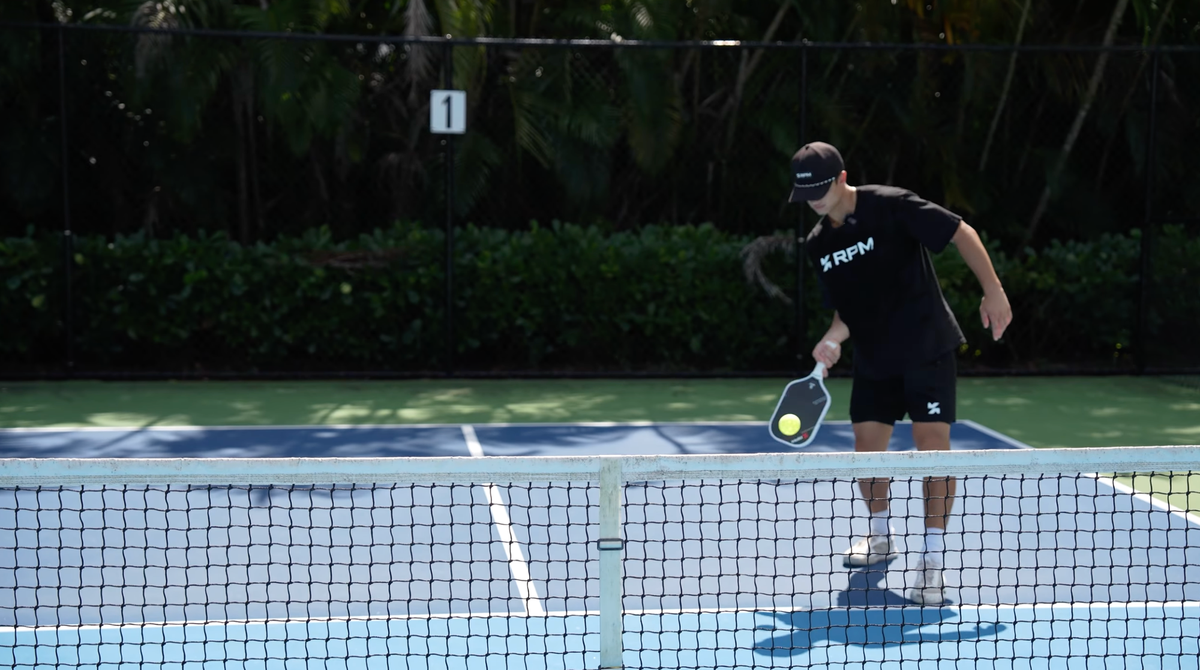
Wrist lag is a related concept that advanced players use to generate extra pop without sacrificing control.
Understanding what wrist lag is and how to train it directly reinforces the preset wrist mechanics you need for a reliable forehand counter.
The two concepts work together: preset the wrist first, then use lag to accelerate through contact.
This combination gives you both consistency and pace, which is exactly what wins hands battles at the kitchen line.
What Is Wrist Lag in Pickleball? The Pro Technique for Power, Spin & Control
Pros use this technique to generate more power, more spin, and better control on serves, returns, drives, and speedups. And you should, too.
The Advanced Move: Closing the Paddle Face for the Forehand Counter at Different Heights
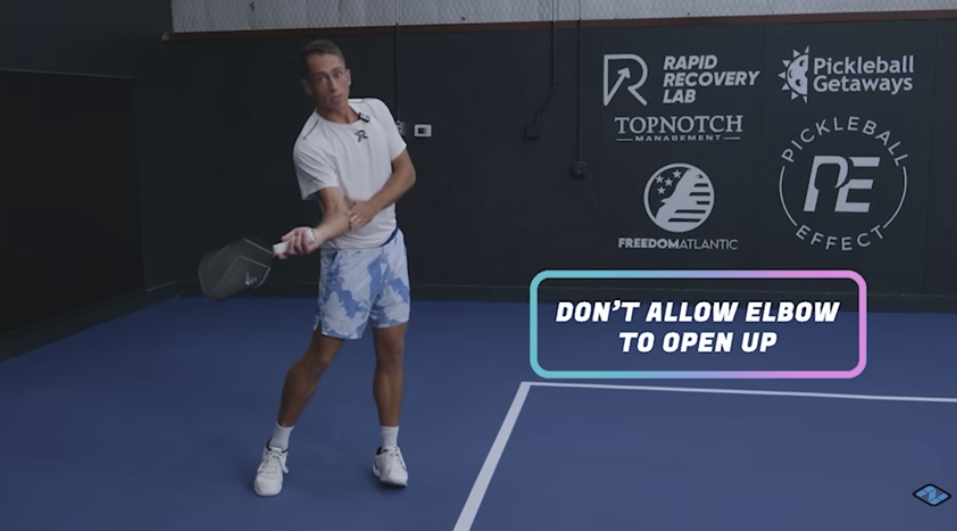
Once you’ve mastered the basic forehand counter with a preset wrist, there’s an advanced technique that can really elevate your game.
Instead of setting your wrist straight up, you can set it with a slightly more closed face.
Think of it like pointing your finger down and out, as if you’re pointing at someone below you.
This closed face position drops the paddle head slightly, which gives you more whip through the ball.
More importantly, it allows you to handle different ball heights with the same swing path.
- When the ball is high, your paddle tip is high.
- When it’s middle, your tip is middle.
- When it’s low, your tip is low.
This matching of paddle tip to ball height is what allows pros to attack low balls with the same aggression they use on high balls.
Without this adjustment, if your paddle is set high, your tip is always high.
You have to drop your entire body to hit a low ball, which takes away your power and control.
By closing the face slightly, you’re adjusting the angle of attack without changing your swing.
It’s a subtle move, but it makes a huge difference.
Richard emphasizes that this doesn’t have to be extreme. Even a tiny bit of closed face makes a difference.
The motion is simple: take your paddle, point your finger down and out, turn it slightly. That’s it.
Once you feel it, you’ll understand why the pros do this on every counter.
Pairing this technique with a stronger understanding of kitchen line offensive tactics will make your forehand counter a genuine weapon rather than just a defensive response.
Pickleball Forehand: How to Hit It Perfectly
A strong forehand is the cornerstone of a strong game. If you can develop consistency here, everything else gets easier.
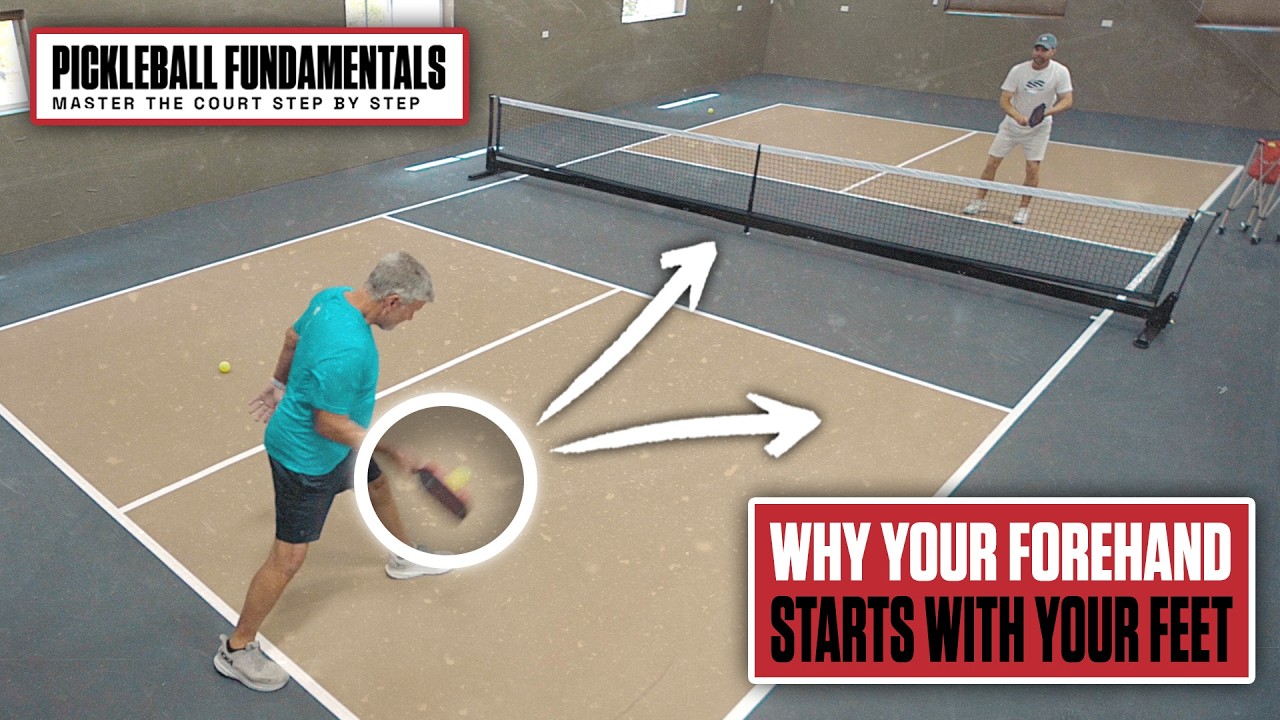
Why the Forehand Counter Works Even When You’re Out of Position
One of the most underappreciated qualities of the compact forehand counter is its reliability under pressure.
Even when you’re caught in the transition zone or pushed out of your ideal position, a locked wrist and a short arm swing gives you a way back into the point.
This is the shot that keeps you alive in rallies that should already be over.
Pickleball Counterattack: Paula Rives’ Pro Technique
PPA pro Paula Rives breaks down the pickleball counterattack, the shot that turns defense into offense. Learn the footwork, positioning, and anticipation needed to neutralize aggressive bangers.

Putting It All Together: The Complete Forehand Counter Motion
The complete forehand counter motion combines all these elements into one smooth, repeatable action. Here’s what it looks like in practice.
- Your shoulders turn slightly as the ball approaches.
- Your arm comes back, but it’s all loaded in your core and shoulders, not in your wrist.
- Your wrist is already preset, either neutral or slightly closed depending on the ball height.
As the ball gets close, you accelerate through it with your arm, keeping your wrist locked.
The result is a controlled, powerful counter-attack that redirects the opponent’s pace back at them.
This motion works from different positions on the court.
- You can counter from tight at the net or from a few feet back.
- You can counter high balls, middle balls, and low balls.
- You can counter fast balls and slow balls.
The mechanics stay the same because you’re not relying on timing a wrist snap. You’re relying on a simple arm motion with a locked wrist.
The reason this works so well is that it removes variables. In tennis or with an eastern grip, you have more options.
With a continental grip and a locked wrist, you have one way to do it. And that one way is incredibly consistent.
For players working toward higher ratings, these are exactly the kinds of shots you need locked in before you can break 5.0.
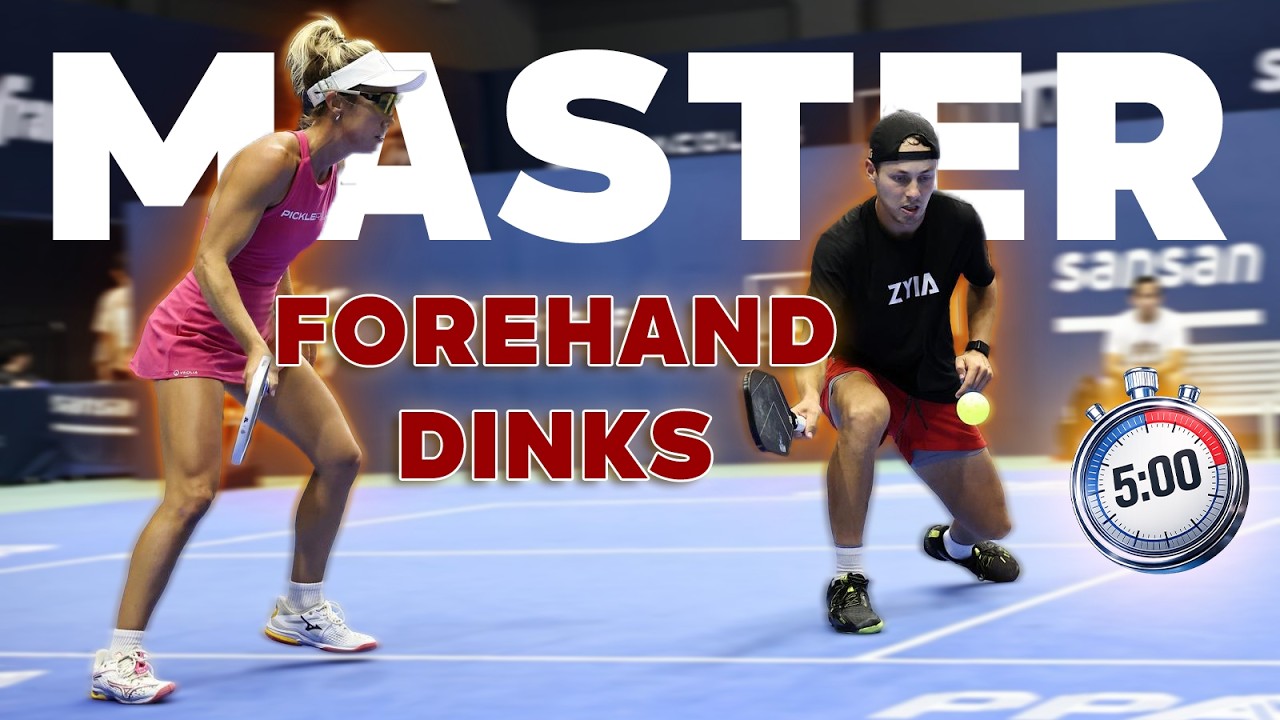
Your Forehand Dink Needs Work: Here’s a 5-Minute Fix from a Pickleball Pro
Sometimes the biggest pickleball improvements come from small, focused adjustments rather than a complete overhaul
Why the Forehand Counter Matters for Your Game in 2026
If you’re struggling in fast hands battles, the forehand counter is probably the culprit.
This is the shot that separates players who can handle pace from players who get pushed around at the net.
When you can counter consistently, you control the tempo of the rally.
You’re not just defending. You’re attacking.
Richard spent years figuring this out on his own. He didn’t have a coach to show him the ping pong model.
He had to problem solve it through trial and error. The good news is that you don’t have to do that. You can skip that step and start using these mechanics right now.
The forehand counter is also one of the most satisfying shots in pickleball. When you hit it right, you feel it.
The ball comes off your paddle with pace and control. Your opponent doesn’t know what hit them.
That feeling is what makes pickleball fun. And it’s within your reach if you’re willing to change your mechanics.
One of the most direct ways to make this shot automatic is by building it into a structured practice routine.
The 12 drills you need to play your best pickleball in 2026 include the kind of repetition work that takes a technical concept like this and turns it into muscle memory.
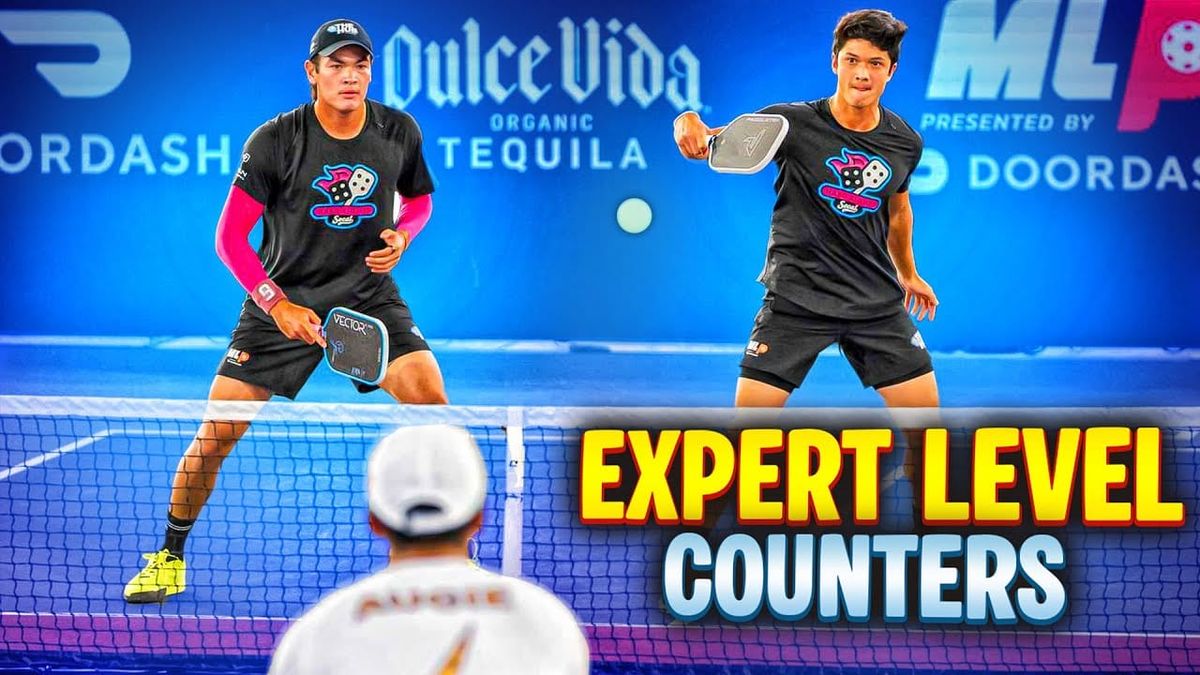
The 3-Zone Counter Technique for Winning Hands Battles at the Kitchen
Counters are point-winners. They’re aggressive shots that put your opponent on their heels. But they only work if you’re positioned correctly and thinking ahead.
Drilling the Forehand Counter: Build the Habit, Then Build the Speed
The best way to improve your forehand counter is through deliberate practice. Have a partner feed you balls at different heights and speeds.
Focus on keeping your wrist preset and your arm motion smooth.
Don’t worry about power at first. Focus on consistency. Once you can hit 10 in a row, then you can start adding pace.
One drill that works well is having your partner give you a dead ball and then hit it at you.
This forces you to counter from a neutral position, which is harder than countering from a ready position.
If you can counter a dead ball, you can counter anything.
Another drill is to have your partner vary the height of the balls. High, middle, low, high, middle, low.
This trains your body to adjust the paddle tip to match the ball height. After a few minutes of this, you’ll start to feel the adjustment happening automatically.
Simple wall drills are another excellent complement to this kind of partner work.
They force you to react quickly with compact mechanics, which is exactly what the forehand counter demands.
For players who want a structured approach to drilling, how much you should drill versus play is a question worth getting right before you invest your court time.
Pro Pickleball Drilling Routine: Train Like a 6.0 DUPR
This advanced pickleball drilling routine focuses on building consistency, cleaner attacks, and faster hands under pressure.
The Role of Hand Speed in Your Forehand Counter Development
Hand speed and the forehand counter are directly connected. The faster your opponent hits, the less time you have to execute.
Developing fast hands at the kitchen line is what allows your mechanics to hold up under pressure.
The four pillars of fast hands in pickleball is essential reading alongside this article.
Building those pillars gives your forehand counter the foundation it needs to perform when the rally gets hot.
Master the Forehand Speed-Up: Fix Common Mistakes (Infographic)
Your forehand speed-up doesn’t have to sail long or crash into the net. A forehand speed-up requires precise mechanics, body positioning, and timing to become a reliable weapon in your game.
Winning Kitchen Line Hands Battles With the Forehand Counter
The forehand counter doesn’t exist in isolation.
It’s one piece of a larger system for winning kitchen line hands battles that includes your backhand, your reset, and your ability to read the opponent’s paddle angle before they even contact the ball.
When all of those elements are working together, you become the kind of player who initiates firefights instead of surviving them.
💡
Frequently Asked Questions
What is a forehand counter in pickleball?
A forehand counter is a compact, arm-driven shot used to redirect an opponent’s pace back at them at the kitchen line. Unlike a drive, it doesn’t generate its own power; it uses the incoming ball’s speed and requires a preset wrist and locked arm to execute with control.
Why do continental grip players struggle with the forehand counter?
Continental grip players struggle because a wrist-based forehand counter causes the paddle face to open at contact, sending the ball long. The fix is to preset the wrist before the swing and drive through the ball with the arm, not the wrist, which keeps the face closed and the shot controlled.
How do I improve my forehand counter consistency?
The fastest path to consistency is drilling the preset wrist position before anything else. Start with slow feeds, lock your wrist, and drive through with your arm. Once you can hit 10 in a row without error, gradually increase the pace of the incoming ball until the motion becomes automatic under pressure.
Can the forehand counter be used offensively?
Yes. A well-executed forehand counter is not a purely defensive shot. When you redirect pace with pace, you can put your opponent on the defensive immediately. The closed paddle face technique adds an element of control that lets you place the ball precisely, turning a defensive response into an aggressive play.
How does the forehand counter differ from a speed-up?
A speed-up is initiated from a neutral or slow exchange; you generate the pace yourself. A forehand counter responds to pace that already exists. The mechanics overlap, but the forehand counter relies on redirecting incoming energy rather than creating new energy, which is why the locked wrist and compact arm swing matter so much more.
Nguồn: thedinkpickleball